
Đề thi Tuyển sinh vào lớp 10 THPT Chuyên Ngoại Ngữ năm 2012 Mã A347819
Báo tài liệu không phù hợp
Xem trước nội dung
Add 1 : Số 5, Ngõ 196 Thái Thịnh, Đống Đa, HN Tel : (04) 35 145 579 – 0985 536 368 Add 2 : Số 24, Ngõ 118 Nguyễn Khánh Toàn, Cầu Giấy, HN Tel : (04) 66 523 699 – 0912 640 088
SMART – SUCCESSFUL – SUPPORTIVE www.smartie.edu.vn 1
ĐẠI HỌC QUỐC GIA HÀ NỘI CỘNG HÒA XÃ HỘI CHỦ NGHĨA VIỆT NAM TRƯỜNG ĐẠI HỌC NGOẠI NGỮ Độc lập – Tự do – Hạnh phúc -------------------------------------- KỲ THI TUYỂN SINH HỆ THPT CHUYÊN NGOẠI NGỮ NĂM 2012
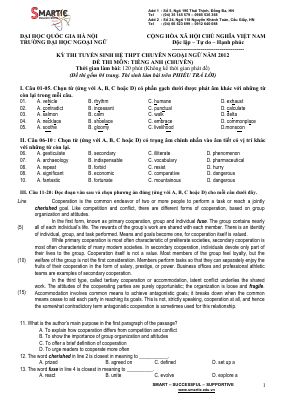
ĐỀ THI MÔN: TIẾNG ANH (CHUYÊN) Thời gian làm bài: 120 phút (Không kể thời gian phát đề) (Đề thi gồm 04 trang. Thí sinh làm bài trên PHIẾU TRẢ LỜI) I. Câu 01-05. Chọn từ (ứng với A, B, C hoặc D) có phần gạch dưới được phát âm khác với những từ còn lại trong mỗi câu. 01. A. vehicle B. rhythm C. humane D. exhaust 02. A. contradict B. incessant C. punctual D. calculate 03. A. salmon B. calm C. walk D. delta 04. A. necklace B. shoelace C. embrace D. commonplace 05. A. soothe B. gloomy C. livelihood D.monsoon II. Câu 06-10 : Chọn từ (ứng với A, B, C hoặc D) có trọng âm chính nhấn vào âm tiết có vị trí khác với những từ còn lại. 06. A. gesticulate B. secondary C. illiterate D. phenomenon 07. A. archaeology B. indispensable C. vocabulary D. pharmaceutical 08. A. repeat B. forbid C. resist D. hurry 08. A. significant B. economic C. comparative D. dangerous 10. A. fantastic B. fortunate C. mountainous D. dangerous III. Câu 11-20: Đọc đoạn văn sau và chọn phương án đúng (ứng với A, B, C hoặc D) cho mỗi câu dưới đây. 11. What is the author’s main purpose in the first paragraph of the passage? A. To explain how cooperation differs from competition and conflict B. To show the importance of group organization and attitudes C. To offer a brief definition of cooperation D. To urge readers to cooperate more often 12. The word cherished in line 2 is closest in meaning to ___________. A. prized B. agreed on C. defined D. set up a 13. The word fuse in line 4 is closest in meaning to __________. A. react B. unite C. evolve D. explore a
Cooperation is the common endeavor of two or more people to perform a task or reach a jointly cherished goal. Like competition and conflict, there are different forms of cooperation, based on group organization and attitudes. In the first form, known as primary cooperation, group and individual fuse. The group contains nearly all of each individual’s life. The rewards of the group’s work are shared with each member. There is an identity of individual, group, and task performed. Means and goals become one, for cooperation itself is valued. While primary cooperation is most often characteristic of preliterate societies, secondary cooperation is most often characteristic of many modern societies. In secondary cooperation, individuals devote only part of their lives to the group. Cooperation itself is not a value. Most members of the group feel loyalty, but the welfare of the group is not the first consideration. Members perform tasks so that they can separately enjoy the fruits of their cooperation in the form of salary, prestige, or power. Business offices and professional athletic teams are examples of secondary cooperation. In the third type, called tertiary cooperation or accommodation, latent conflict underlies the shared work. The attitudes of the cooperating parties are purely opportunistic; the organization is loose and fragile. Accommodation involves common means to achieve antagonistic goals; it breaks down when the common means cease to aid each party in reaching its goals. This is not, strictly speaking, cooperation at all, and hence the somewhat contradictory term antagonistic cooperation is sometimes used for this relationship.
Line (5) (10) (15)
Trên đây là phần đầu tài liệu — bấm Đọc sách để xem đầy đủ.