
NEC MOCK TEST - NATION CONTEST (MOCK TEST) (13 pages) Mã A797090
Báo tài liệu không phù hợp
Xem trước nội dung
Page 1 of 12 pages
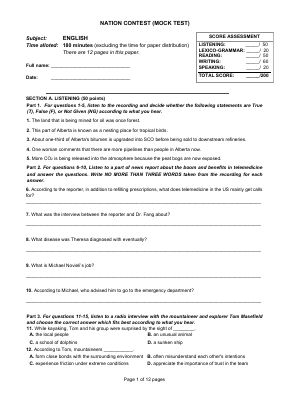
NATION CONTEST (MOCK TEST)
Subject: ENGLISH Time alloted: 180 minutes (excluding the time for paper distribution)
There are 12 pages in this paper.
Full name: ______________________________
Date: ______________________________
SECTION A. LISTENING (50 points)
Part 1. For questions 1-5, listen to the recording and decide whether the following statements are True
(T), False (F), or Not Given (NG) according to what you hear.
1. The land that is being mined for oil was once forest.
2. This part of Alberta is known as a nesting place for tropical birds.
3. About one-third of Alberta's bitumen is upgraded into SCO before being sold to downstream refineries.
4. One woman comments that there are more pipelines than people in Alberta now.
5. More CO2 is being released into the atmosphere because the peat bogs are now exposed.
Part 2. For questions 6-10, Listen to a part of news report about the boom and benefits in telemedicine
and answer the questions. Write NO MORE THAN THREE WORDS taken from the recording for each answer.
6. According to the reporter, in addition to refilling prescriptions, what does telemedicine in the US mainly get calls for? _________________________________________________________________________________________ 7. What was the interview between the reporter and Dr. Fang about?
_________________________________________________________________________________________
8. What disease was Theresa diagnosed with eventually?
_________________________________________________________________________________________
9. What is Michael Novieli’s job?
_________________________________________________________________________________________
10. According to Michael, who advised him to go to the emergency department?
_________________________________________________________________________________________
Part 3. For questions 11-15, listen to a radio interview with the mountaineer and explorer Tom Masefield and choose the correct answer which fits best according to what you hear. 11. While kayaking, Tom and his group were surprised by the sight of ________.
A. the local people B. an unusual animal
C. a school of dolphins D. a sunken ship
12. According to Tom, mountaineers ___________.
A. form close bonds with the surrounding environment B. often misunderstand each other's intentions
C. experience friction under extreme conditions D. appreciate the importance of trust in the team
SCORE ASSESSMENT
LISTENING: _____/ 50 LEXICO-GRAMMAR: _____/ 20 READING: _____/ 50 WRITING: _____/ 60 SPEAKING: _____/ 20
TOTAL SCORE: _____/200
Page 2 of 12 pages
13. Regarding the problem with frostbite on Everest, Tom is ________.
A. indifferent B. philosophical C. dismissive D. frustrated
14. The team's first attempt to climb Carstensz Pyramid failed due to______.
A. disagreements with their sponsors B. disturbances caused by local dissidents
C. mechanical problems with their helicopter D. a lack of sufficient time and funding
15. Tom's conquest of Carstensz Pyramid was special because it was ______.
A. the second time he had climbed it B. the first time anyone had done this
C. a dream he had had since childhood D. his second historic achievement for his country
Part 4. For questions 16-25. listen to a talk about the human nose and complete the following sentences.
Write NO MORE THAN THREE WORDS taken from the recording for each blank. Our noses are composed of (16) ____________________________ rather than bone. Similar to our other
external organs, they evolved to contribute to our survival by assisting us in eating. Thanks to their proximity to
our mouth with (17) ____________________________, noses enable us to smell if something has rotted. In
addition, noses help infants by making sure that they don't (18) ____________________________ while being
nursed.
Their outer part consists mainly of resilient tissue, which means they are softer and much less likely to …
Trên đây là phần đầu tài liệu — bấm Đọc sách để xem đầy đủ.