
KỲ THI CHỌN HỌC SINH GIỎI LỚP 12 THPT NĂM HỌC 2017-2018 Ngày thi 25 tháng 9 năm 2017 Môn thi TIẾNG ANH- LỚP 12 THPT tỉnh Tây Ninh Mã A842260
Báo tài liệu không phù hợp
Xem trước nội dung
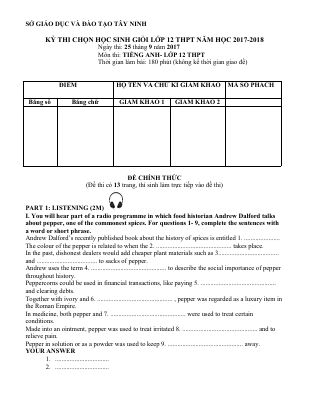
SỞ GIÁO DỤC VÀ ĐÀO TẠO TÂY NINH
KỲ THI CHỌN HỌC SINH GIỎI LỚP 12 THPT NĂM HỌC 2017-2018
Ngày thi: 25 tháng 9 năm 2017 Môn thi: TIẾNG ANH- LỚP 12 THPT Thời gian làm bài: 180 phút (không kể thời gian giao đề)
ĐIỂM HỌ TÊN VÀ CHỮ KÍ GIÁM KHẢO MÃ SỐ PHÁCH
Bằng số Bằng chữ GIÁM KHẢO 1 GIÁM KHẢO 2
ĐỀ CHÍNH THỨC (Đề thi có 13 trang, thí sinh làm trực tiếp vào đề thi)
PART 1: LISTENING (2M) I. You will hear part of a radio programme in which food historian Andrew Dalford talks about pepper, one of the commonest spices. For questions 1- 9, complete the sentences with a word or short phrase. Andrew Dalford’s recently published book about the history of spices is entitled 1. ...................... The colour of the pepper is related to when the 2. .............................................. takes place. In the past, dishonest dealers would add cheaper plant materials such as 3..................................... and ..................................... to sacks of pepper. Andrew uses the term 4. .............................................. to describe the social importance of pepper throughout history. Peppercorns could be used in financial transactions, like paying 5. .............................................. and clearing debts. Together with ivory and 6. .............................................. , pepper was regarded as a luxury item in the Roman Empire. In medicine, both pepper and 7. .............................................. were used to treat certain conditions. Made into an ointment, pepper was used to treat irritated 8. .............................................. and to relieve pain. Pepper in solution or as a powder was used to keep 9. .............................................. away. YOUR ANSWER
1. ................................. 2. .................................
3. ................................. 4. ................................. 5. ................................. 6. ................................. 7. ................................. 8. ................................. 9. ................................. II. You will hear part of a radio discussion about graphology, the study of handwriting. For questions 10-14, choose the answer (A, B, C or D) which fits best according to what you hear. 10. According to Richard, comments on a client’s personality traits should only be made if the graphologist
A. is sure that the sample of handwriting is genuine. B. is sure his results are supported by the rest of his team. C. can back up his initial findings with further evidence. D. can confirm his findings in different handwriting samples. 11. What is Maria’s view of the conclusions which graphologists arrive at?
A. The rules of interpretation are not clear. B. The connections have not been proved. C. More detailed interpretation is needed. D. Research is needed into the way writing is taught. 12. What, in Richard’s view, is the key to an understanding of a client’s personality?
A. the way in which the client learnt to write B. the variations in the client's individual letters C. the way the client’s handwriting has developed D. the influence of current trends on the client’s handwriting 13. According to Richard, some businesses with North American links
A. use graphology reluctantly in recruitment. B. are unwilling to disclose that they use graphology. C. are skeptical about the value of graphology. D. are trading more successfully because of graphology. 14. What does Maria conclude about the use of graphology?
A. It has become a source of discontent. B. It is used by few serious psychologists. C. Its educational value has not been proved. D. It is not appropriate for use as a recruitment tool. YOUR ANSWER:
10.................................. 11.................................. 12.................................. 13.................................. 14.................................. III. You will hear two friends, Dominic and Sue, talking about formality in the workplace. For …
Trên đây là phần đầu tài liệu — bấm Đọc sách để xem đầy đủ.