
ĐỀ THI CHỌN ĐỘI TUYỂN THI HỌC SINH GIỎI QUỐC GIA MÔN TIẾNG ANH NĂM HỌC 2017-2018 TỈNH LÀO CAI (BÀI THI 02) Mã A134634
Báo tài liệu không phù hợp
Xem trước nội dung
SỞ GIÁO DỤC VÀ ĐÀO TẠO LÀO CAI ĐỀ THI CHÍNH THỨC
KỲ THI CHỌN ĐỘI TUYỂN THI HỌC SINH GIỎI QUỐC GIA
NĂM HỌC: 2017-2018
Môn thi: TIẾNG ANH Thời gian thi: 180 phút (không kể thời gian giao đề) Ngày thi: 4/10/2017 Đề thi có 15 trang
Thí sinh không được sử dụng tài liệu, kể cả từ điển. Giám thị không giải thích gì thêm.
Số phách
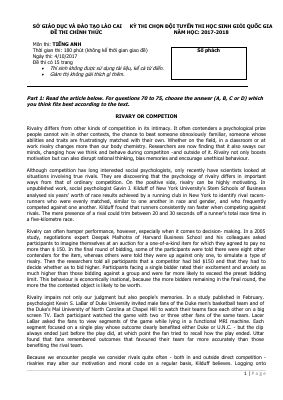
Part 1: Read the article below. For questions 70 to 75, choose the answer (A, B, C or D) which you think fits best according to the text.
RIVARY OR COMPETION
Rivalry differs from other kinds of competition in its intimacy. It often contenders a psychological prize people cannot win in other contexts, the chance to beat someone obnoxiously familiar, someone whose abilities and traits are frustratingly matched with their own. Whether on the field, in a classroom or at work rivalry changes more than our body chemistry. Researchers are now finding that it also sways our minds, changing how we think and behave during competiton -and outside of it. Rivalry not only boosts motivation but can also disrupt rational thinking, bias memories and encourage unethical behaviour.
Although competition has long interested social psychologists, only recently have scientists looked at situations involving true rivals. They are discovering that the psychology of rivalry differs in important ways from that of ordinary competition. On the positive side, rivalry can be highly motivating. In unpublished work, social psychologist Gavin J. Kilduff of New York University's Stem Schools of Business analysed six years' worth of race results achieved by a running club in New York to identify rival racers- runners who were evenly matched, similar to one another in race and gender, and who frequently competed against one another. Kilduff found that runners consistently ran faster when competing against rivals. The mere presence of a rival could trim between 20 and 30 seconds off a runner's total race time in a five-kilometre race.
Rivalry can often hamper performance, however, especially when it comes to decision- making. In a 2005 study, negotiations expert Deepak Malhotra of Harvard Business School and his colleagues asked participants to imagine themselves at an auction for a one-of-a-kind item for which they agreed to pay no more than $ 150. In the final round of bidding, some of the participants were told there were eight other contenders for the item, whereas others were told they were up against only one, to simulate a type of rivalry. Then the researchers told all participants that a competitor had bid $150 and that they had to decide whether as to bid higher. Participants facing a single bidder rated their excitement and anxiety as much higher than those bidding against a group and were far more likely to exceed the preset bidding limit. This behaviour is economically inational, because the more bidders remaining in the final round, the more the the contested object is likely to be worth.
Rivalry impairs not only our judgment but also people's memories. In a study published in February. psychologist Kevin S. LaBar of Duke University invited male fans of the Duke men's basketball team and of the Duke's Mal University of North Carolina at Chapel Hill to watch their teams face each other on a big screen TV. Each participant watched the game with two or three other fans of the same team. Lacer LaBar asked the fans to view segments of the game while lying in a functional MRI machine. Each segment focused on a single play whose outcome clearly benefited either Duke or U.N.C. - but the clip always ended just before the play did, at which point the fan tried to recall how the play ended. Uttar found that fans remembered outcomes that favoured their team far more accurately than those benefiting the rival team.
Because we encounter people we consider rivals quite often - both in and outside direct competition - rivalries may alter our motivation and moral code on a regular basis, Kilduff believes. Logging onto
1 | P a g e
Trên đây là phần đầu tài liệu — bấm Đọc sách để xem đầy đủ.