
ĐỀ THI CHỌN HỌC SINH GIỎI CẤP TỈNH SÓC TRĂNG Năm học 2014-2015 có đáp án Mã A221561
Báo tài liệu không phù hợp
Xem trước nội dung
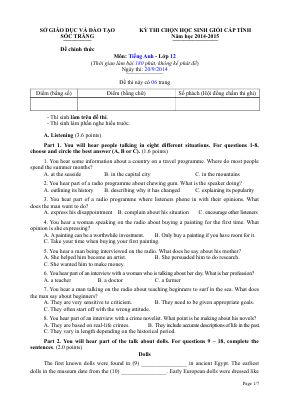
SỞ GIÁO DỤC VÀ ĐÀO TẠO KỲ THI CHỌN HỌC SINH GIỎI CẤP TỈNH SÓC TRĂNG Năm học 2014-2015 ¯¯¯¯¯¯¯¯¯¯ ¯¯¯¯¯¯¯¯¯¯¯¯¯¯¯¯ Đề chính thức
Môn: Tiếng Anh - Lớp 12 (Thời gian làm bài 180 phút, không kể phát đề)
Ngày thi: 20/9/2014
¯¯¯¯¯¯¯¯¯¯¯¯¯ Đề thi này có 06 trang
Điểm (bằng số) Điểm (bằng chữ) Số phách (Hội đồng chấm thi ghi)
- Thí sinh làm trên đề thi. - Thí sinh làm phần nghe hiểu trước.
A. Listening (3.6 points)
Part 1. You will hear people talking in eight different situations. For questions 1-8, choose and circle the best answer (A, B or C). (1.6 points)
1. You hear some information about a country on a travel programme. Where do most people spend the summer months?
A. at the seaside B. in the capital city C. in the mountains
2. You hear part of a radio programme about chewing gum. What is the speaker doing? A. outlining its history B. describing why it has changed C. explaining its popularity
3. You hear part of a radio programme where listeners phone in with their opinions. What does the man want to do?
A. express his disappointment B. complain about his situation C. encourage other listeners
4. You hear a woman speaking on the radio about buying a painting for the first time. What opinion is she expressing?
A. A painting can be a worthwhile investment. B. Only buy a painting if you have room for it. C. Take your time when buying your first painting.
5. You hear a man being interviewed on the radio. What does he say about his mother? A. She helped him become an artist. B. She persuaded him to do research. C. She wanted him to make money.
6. You hear part of an interview with a woman who is talking about her day. What is her profession? A. a teacher B. a doctor C. a farmer
7. You hear a man talking on the radio about teaching beginners to surf in the sea. What does the man say about beginners?
A. They are very sensitive to criticism. B. They need to be given appropriate goals. C. They often start off with the wrong attitude.
8. You hear part of an interview with a crime novelist. What point is he making about his novels? A. They are based on real-life crimes. B. They include accurate descriptions of life in the past. C. They vary in length depending on the historical period.
Part 2. You will hear part of the talk about dolls. For questions 9 – 18, complete the sentences. (2.0 points)
Dolls
The first known dolls were found in (9) ________________ in ancient Egypt. The earliest dolls in the museum date from the (10) ________________. Early European dolls were dressed like
Page 1/7
(11) _______________. On the 17th–century dolls, you can see details like the (12) _______________. The 17th–century dolls may cost as much as (13) ________________ each. Collectors look for examples in perfect condition with their (14) ________________. The 19th– century dolls had (15) ________________ and real hair. If you can take off the dolls’ hair, you may see the (16) _________________ underneath. Before the 20th century, all dolls were (17) _______________, not babies. From the 1930s, dolls were made of (18) ________________.
B. Lexico - Grammar (7.4 points)
Part 1. Choose and circle the best answer (A, B, C or D) to complete each sentence. (2.0 points)
1. The dealer wanted 400 dollars, I wanted to pay 300 dollars, and we finally agreed to ____ the difference.
A. divide B. split C. drop D. decrease
2. You can use my dictionary ______ you bring it back tomorrow.
A. in spite of B. although C. nevertheless D. as long as
3. ____ how angry he was, he would never resort to violence.
A. Because B. No problem C. No matter D. Although
4. It’s difficult to tell identical twins ____ .
A. apart B. on C. over D. out
5. The Foreign Minister held talks with his Japanese ____ .
A. collaborator B. counterpart C. partner D. colleague
6. We played the game ____ the rules.
A. on account of B. ahead of C. according to D. apart from
7. ____ most men, my father enjoys cooking.
A. Unlikely B. Dislike C. Not alike D. Unlike
8. …
Trên đây là phần đầu tài liệu — bấm Đọc sách để xem đầy đủ.