
(Đề thi) ĐỀ THI CHỌN ĐỘI TUYỂN DỰ THI HỌC SINH GIỎI QUỐC GIA THPT NĂM 2016 MÔN TIẾNG ANH Mã A225152
Báo tài liệu không phù hợp
Xem trước nội dung
1/15
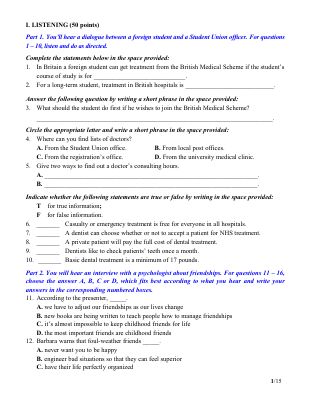
I. LISTENING (50 points) Part 1. You’ll hear a dialogue between a foreign student and a Student Union officer. For questions 1 – 10, listen and do as directed. Complete the statements below in the space provided: 1. In Britain a foreign student can get treatment from the British Medical Scheme if the student‟s
course of study is for ____________________________. 2. For a long-term student, treatment in British hospitals is ___________________________. Answer the following question by writing a short phrase in the space provided: 3. What should the student do first if he wishes to join the British Medical Scheme?
________________________________________________________________________. Circle the appropriate letter and write a short phrase in the space provided: 4. Where can you find lists of doctors? A. From the Student Union office. B. From local post offices. C. From the registration‟s office. D. From the university medical clinic. 5. Give two ways to find out a doctor‟s consulting hours. A. _________________________________________________________________. B. _________________________________________________________________. Indicate whether the following statements are true or false by writing in the space provided: T for true information; F for false information. 6. _______ Casualty or emergency treatment is free for everyone in all hospitals. 7. _______ A dentist can choose whether or not to accept a patient for NHS treatment. 8. _______ A private patient will pay the full cost of dental treatment. 9. _______ Dentists like to check patients‟ teeth once a month. 10. _______ Basic dental treatment is a minimum of 17 pounds. Part 2. You will hear an interview with a psychologist about friendships. For questions 11 – 16, choose the answer A, B, C or D, which fits best according to what you hear and write your answers in the corresponding numbered boxes. 11. According to the presenter, _____.
A. we have to adjust our friendships as our lives change B. new books are being written to teach people how to manage friendships C. it‟s almost impossible to keep childhood friends for life D. the most important friends are childhood friends 12. Barbara warns that foul-weather friends _____.
A. never want you to be happy B. engineer bad situations so that they can feel superior C. have their life perfectly organized
2/15
D. can spoil the times when you are feeling good about life 13. The danger of a trophy friend is that _____.
A. he or she will inhibit your social life B. you may develop unrealistic expectations C. he or she will push you to be a higher achiever D. he or she will expect you to become more popular 14. A sisterly friend _____.
A. can be relied on but may be too involved in your life B. will resent other close friendships in your life C. will be as close to your family as she is to you D. will want to go out on dates with you and your new partner 15. According to Barbara, a good friend _____.
A. probably needs to be someone that you see very often B. tends to ask for your help slightly more than you would like but you tolerate it C. doesn‟t expend too much of your time or energy D. never puts you in a serious mood 16. When making new friends, _____.
A. try to be as funny as you can B. don‟t mention serious issues before you have got to know them well C. be sensitive to their need for space D. spend as much time with them as you can Write your answers here:
11. 12. 13. 14. 15. 16. Part 3. You will hear a researcher talking about communication in the environmental science fields, and how communication on environmental issues could be improved. For questions 17 – 25, complete the sentences with a word or a short phrase in the space provided. 17. There is a deep cultural view that knowledge leads people to do __________________________.
18. However, to solve environmental problems, obstacles must also be _______________________.
19. The idea that knowledge automatically leads to the correct behaviour is …
Trên đây là phần đầu tài liệu — bấm Đọc sách để xem đầy đủ.