
Xem trước nội dung
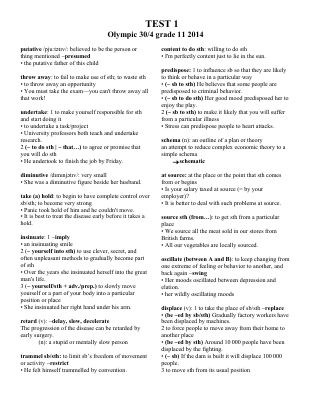
TEST 1 Olympic 30/4 grade 11 2014
putative /pjuːtətɪv/: believed to be the person or thing mentioned ~presumed • the putative father of this child
throw away: to fail to make use of sth; to waste sth • to throw away an opportunity • You must take the exam—you can't throw away all that work!
undertake: 1 to make yourself responsible for sth and start doing it • to undertake a task/project • University professors both teach and undertake research. 2 (~ to do sth | ~ that…) to agree or promise that you will do sth • He undertook to finish the job by Friday.
diminutive /dɪmɪnjətɪv/: very small • She was a diminutive figure beside her husband.
take (a) hold: to begin to have complete control over sb/sth; to become very strong • Panic took hold of him and he couldn't move. • It is best to treat the disease early before it takes a hold.
insinuate: 1 ~imply • an insinuating smile 2 (~ yourself into sth) to use clever, secret, and often unpleasant methods to gradually become part of sth • Over the years she insinuated herself into the great man's life. 3 (~ yourself/sth + adv./prep.) to slowly move yourself or a part of your body into a particular position or place • She insinuated her right hand under his arm.
retard (v): ~delay, slow, decelerate The progression of the disease can be retarded by early surgery.
(n): a stupid or mentally slow person
trammel sb/sth: to limit sb’s freedom of movement or activity ~restrict • He felt himself trammelled by convention.
content to do sth: willing to do sth • I'm perfectly content just to lie in the sun.
predispose: 1 to influence sb so that they are likely to think or behave in a particular way • (~ sb to sth) He believes that some people are predisposed to criminal behavior. • (~ sb to do sth) Her good mood predisposed her to enjoy the play. 2 (~ sb to sth) to make it likely that you will suffer from a particular illness • Stress can predispose people to heart attacks.
schema (n): an outline of a plan or theory an attempt to reduce complex economic theory to a simple schema
schematic
at source: at the place or the point that sth comes from or begins • Is your salary taxed at source (= by your employer)? • It is better to deal with such problems at source.
source sth (from…): to get sth from a particular place • We source all the meat sold in our stores from British farms. • All our vegetables are locally sourced.
oscillate (between A and B): to keep changing from one extreme of feeling or behavior to another, and back again ~swing • Her moods oscillated between depression and elation. • her wildly oscillating moods
displace (v): 1 to take the place of sb/sth ~replace • (be ~ed by sb/sth) Gradually factory workers have been displaced by machines. 2 to force people to move away from their home to another place • (be ~ed by sth) Around 10 000 people have been displaced by the fighting. • (~ sb) If the dam is built it will displace 100 000 people. 3 to move sth from its usual position
• (be ~ed by sth) Check for roof tiles that have been displaced by the wind.
bond (with sb): to develop or create a relationship of trust with sb • Mothers who are depressed sometimes fail to bond with their children.
sb’s word is their bond: sb’s promise can be relied on completely
academic (n): a person who teaches and/or does research at a university or college a leading/distinguished/prominent academic
reciprocity /ˌresɪˈprɑːsəti/: a situation in which two people, countries, etc. provide the same help or advantages to each other
reciprocation (n): the fact of behaving or feeling towards sb in the same way as they behave or feel towards you
moisten (sth): to become or make sth slightly wet
moisturize (sth): to put a special cream on your skin to make it less dry
(like rats) deserting/leaving a sinking ship
in respect of sth: 1 about; relating to • A writ was served on the firm in respect of their unpaid bill. 2 in payment for sth money received in respect of overtime worked
with …
Trên đây là phần đầu tài liệu — bấm Đọc sách để xem đầy đủ.