Đề Thi (Chính Thức) Môn Tiếng Anh 11 - Duyên Hải Và Đồng Bằng Bắc Bộ năm 2022 có đáp án
Xem trước nội dung
Page 1 of 17
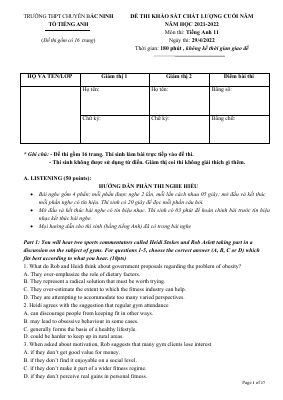
Ĉ͉ thi g͛m 17 trang)
Kǣ THI HӐC SINH GIӒ, &È& 75ѬӠNG THPT CHUYÊN
KHU VӴC DUYÊN HҦ, 9¬ ĈӖNG BҴNG BҲC BӜ
LҪN THӬ XIII 1Ă0 22
Ĉӄ THI MÔN: TIӂNG ANH 11 Thͥi gian: 180 phút (Không k͋ thͥi gian phát ÿ͉)
Ngày thi:14/7/2022 (Thí sinh làm bài vào Phi͇u tr̫ lͥi)
A. LISTENING (50 points):
+ѬӞNG DҮN PHҪN THI NGHE HIӆU x Bài nghe g͛m 4 ph̯n; m͟i ph̯Q ÿ˱ͫc nghe 2 l̯n, m͟i l̯n cách nhau 05 giây; mͧ ÿ̯u và
k͇t thúc m͟i ph̯n nghe có tín hi͏X 7Kt VLQK Fy JLk\ ÿ͋ ÿ͕c m͟i ph̯n câu h͗i. x Mͧ ÿ̯u và k͇t thúc bài nghe có tín hi͏u nh̩F 7Kt VLQK Fy SK~W ÿ͋ hoàn ch͑QK EjL WU˱ͣc
tín hi͏u nh̩c k͇t thúc bài nghe. x M͕L K˱ͣng d̳n cho thí sinh (b̹ng ti͇QJ $QK ÿm Fy WURQJ Eji nghe
Part 1. For questions 1-5, you will hear a woman talking about caffein. Listen and decide
whether the following sentences are true (T) or false (F). Write your answers in the
corresponding numbered boxes on the answer sheet. (10 points)
l. The desired effect of caffeine is brought about as it facilitates the proper function of
Adenosine receptors in the brain.
2. People around the world have consumed caffeine-infused products on a daily basis for
centuries.
3. The popularity of tea in Britain led to it being consumed in China later on.
4. Caffeinated drinks have integrated themselves into the drinking culture in the United States.
5. Pure caffeine poses a serious health risk, resulting even in dealths.
Part 2. For questions 6-10, you will hear a lecture about water. Listen and answer the
questions. Write NO MORE THAN THREE WORDS taken from the recording for each
answer in the corresponding numbered boxes on the answer sheet. (10 points)
6. What are the two features of water that concern people everywhere?
7. What is the main use of water in our everyday life?
8. Besides rivers, where can we find the purest water?
9. What hinders people from utilising rainwater in Oceania, besides its increasingly limited
amount?
10. What need(s) removing from water before we use it?
Ĉӄ CHÍNH THӬC
Page 2 of 17
Part 3. For questions 11-15, you will hear two nutritionists, Fay Wells and George Fisher,
discussing methods of food production. Choose the answer (A, B, C or D) which fits best
according to what you hear and write your answers in the corresponding numbered boxes on
the answer sheet. (10 points)
11. Looking at reports on the subject of GM foods, Fay feels _______.
A. pleased to read that the problem of food shortages is being addressed
B. surprised that the fears of the public are not allayed by them
C. frustrated by contradictory conclusions
D. critical of the scientists' methodology
12. What does George suggest about organic foods?
A. Consumers remain surprisingly poorly informed about them.
B. People need to check out the claims made about them.
C. They need to be made more attractive to meat-eaters.
D. They may become more widely affordable in frture.
13. What is George's opinion of 'vertical farming'?
A. It could provide a realistic alternative to existing methods.
B. It's a highly impractical scheme dreamt up by architects.
C. It's unlikely to go much beyond the experimental stage.
D. It has the potential to reduce consumpyon of energy.
14. George and Fay agree that the use of nanotechnology in food production will _______.
A. reduce the need for dietary supplements
B. simplify the process of food-labelling
C. complicate things for the consumer
D. introduce potential health risks
15. In Fay's view, returning to self-suffciency is only an option for people who _______.
A. have no need to get a return on their investment
B. are willing to accept a high level of regulation
C. reject the values of a consumer society
D. already have sufficient set-up funds
Part 4. For questions 16-25, you will listen to a recording of a presenter talking about Machu
Picchu. Complete the summary by writing NO MORE THAN FOUR WORDS and/or A
NUMBER in each gap. Write your answers in the corresponding numbered boxes on the
answer sheet. …
Trên đây là phần đầu tài liệu — bấm Đọc sách để xem đầy đủ.