
Xem trước nội dung
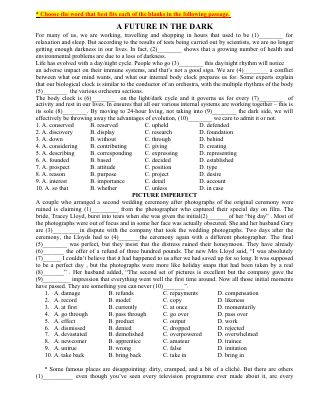
OPEN CLOZE TEST
Passage 1
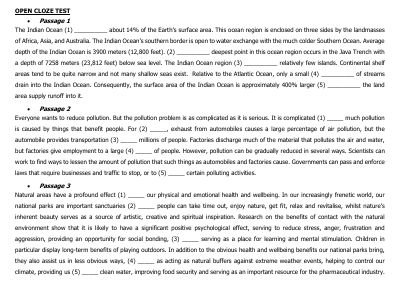
The Indian Ocean (1) __________ about 14% of the Earth’s surface area. This ocean region is enclosed on three sides by the landmasses
of Africa, Asia, and Australia. The Indian Ocean’s southern border is open to water exchange with the much colder Southern Ocean. Average
depth of the Indian Ocean is 3900 meters (12,800 feet). (2) __________ deepest point in this ocean region occurs in the Java Trench with
a depth of 7258 meters (23,812 feet) below sea level. The Indian Ocean region (3) __________ relatively few islands. Continental shelf
areas tend to be quite narrow and not many shallow seas exist. Relative to the Atlantic Ocean, only a small (4) __________ of streams
drain into the Indian Ocean. Consequently, the surface area of the Indian Ocean is approximately 400% larger (5) __________ the land
area supply runoff into it.
Passage 2
Everyone wants to reduce pollution. But the pollution problem is as complicated as it is serious. It is complicated (1) _____ much pollution
is caused by things that benefit people. For (2) _____, exhaust from automobiles causes a large percentage of air pollution, but the
automobile provides transportation (3) _____ millions of people. Factories discharge much of the material that pollutes the air and water,
but factories give employment to a large (4) _____ of people. However, pollution can be gradually reduced in several ways. Scientists can
work to find ways to lessen the amount of pollution that such things as automobiles and factories cause. Governments can pass and enforce
laws that require businesses and traffic to stop, or to (5) _____ certain polluting activities.
Passage 3
Natural areas have a profound effect (1) _____ our physical and emotional health and wellbeing. In our increasingly frenetic world, our
national parks are important sanctuaries (2) _____ people can take time out, enjoy nature, get fit, relax and revitalise, whilst nature’s
inherent beauty serves as a source of artistic, creative and spiritual inspiration. Research on the benefits of contact with the natural
environment show that it is likely to have a significant positive psychological effect, serving to reduce stress, anger, frustration and
aggression, providing an opportunity for social bonding, (3) _____ serving as a place for learning and mental stimulation. Children in
particular display long-term benefits of playing outdoors. In addition to the obvious health and wellbeing benefits our national parks bring,
they also assist us in less obvious ways, (4) _____ as acting as natural buffers against extreme weather events, helping to control our
climate, providing us (5) _____ clean water, improving food security and serving as an important resource for the pharmaceutical industry.
Passage 4
Another reason that music is so popular (1) __________ the variety of settings in which one can enjoy his or her favourite kind of music.
You can go to a church to hear great religious music, or to a concert hall to hear a well-known classical symphony. (2) __________ another
night, you might go to a small club to listen to an up-and-coming jazz group while you enjoy a drink. A few nights (3) __________, you
might go with some friends to join thousands of other people in a stadium to hear your favourite rock band play in your city on a world
tour. And, back at your house or apartment, you can relax while you put in a tape or CD and (4) __________ to your favourite artists again
and again in your (5) __________ home.
Passage 5 HOW DO THEY MAKE CARTOONS?
Cartoons (1) __________ called animated films. Artists draw the scenes. They draw the background and the characters. Each drawing of
the character is slightly different. (2) __________ example, the legs are (3) __________ different places if the character is running. A
special camera takes pictures of each scene the artist has drawn. When the pictures are played back, it looks like the character is …
Trên đây là phần đầu tài liệu — bấm Đọc sách để xem đầy đủ.