
28 Guided cloze tests - ôn thi học sinh giỏi THPT (30 trang) Mã A913330
Báo tài liệu không phù hợp
Xem trước nội dung
1
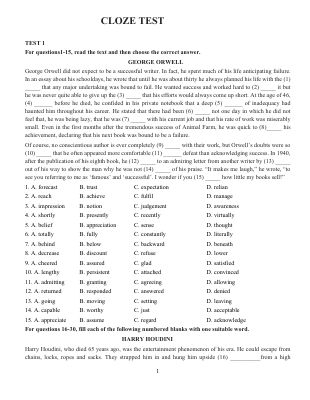
CLOZE TEST
TEST 1
For questions1-15, read the text and then choose the correct answer.
GEORGE ORWELL
George Orwell did not expect to be a successful writer. In fact, he spent much of his life anticipating failure. In an essay about his schooldays, he wrote that until he was about thirty he always planned his life with the (1) _____ that any major undertaking was bound to fail. He wanted success and worked hard to (2) _____ it but he was never quite able to give up the (3) _____ that his efforts would always come up short. At the age of 46, (4) ______ before he died, he confided in his private notebook that a deep (5) ______ of inadequacy had haunted him throughout his career. He stated that there had been (6) _____ not one day in which he did not feel that, he was being lazy, that he was (7) _____ with his current job and that his rate of work was miserably small. Even in the first months after the tremendous success of Animal Farm, he was quick to (8)_____ his achievement, declaring that his next book was bound to be a failure.
Of course, no conscientious author is ever completely (9) _____ with their work, but Orwell’s doubts were so (10) _____ that he often appeared more comfortable (11) ______ defeat than acknowledging success. In 1940, after the publication of his eighth book, he (12) _____ to an admiring letter from another writer by (13) _____ out of his way to show the man why he was not (14) _____ of his praise. “It makes me laugh,” he wrote, “to see you referring to me as ‘famous’ and ‘successful’. I wonder if you (15) _____ how little my books sell!”
1. A. forecast B. trust C. expectation D. relian
2. A. reach B. achieve C. fulfil D. manage
3. A. impression B. notion C. judgement D. awareness
4. A. shortly B. presently C. recently D. virtually
5. A. belief B. appreciation C. sense D. thought
6. A. totally B. fully C. constantly D. literally
7. A. behind B. below C. backward D. beneath
8. A. decrease B. discount C. refuse D. lower
9. A. cheered B. assured C. glad D. satisfied
10. A. lengthy B. persistent C. attached D. convinced
11. A. admitting B. granting C. agreeing D. allowing
12. A. returned B. responded C. answered D. denied
13. A. going B. moving C. setting D. leaving
14. A. capable B. worthy C. just D. acceptable
15. A. appreciate B. assume C. regard D. acknowledge
For questions 16-30, fill each of the following numbered blanks with one suitable word.
HARRY HOUDINI
Harry Houdini, who died 65 years ago, was the entertainment phenomenon of his era. He could escape from chains, locks, ropes and sacks. They strapped him in and hung him upside (16) __________from a high
2
building and he somehow freed (17) ____________. They locked him in a packing case and sank him in Liverpool docks and minutes (18) ___________ he surfaced smiling.
Houdini would usually (19) _____________ his equipment to be examined by the audience. The chains, locks and packing cases all seemed line, (20) ____________ it was tempting to conclude that he possessed superhuman powers. However, there was (21) _____________ physically remarkable about Houdini (22) ________________ for his bravery, dexterity and fitness. His nerve was so cool that he could relax when buried six feet underground (23) ______________ they came to dig him up. His fingers were so strong that he (24) ____________ undo a strap or manipulate keys through the canvas of a mail hag. He made (25) ____________ comprehensive study of locks and was able to conceal tools about his person in a way (26) ____________ fooled even the doctors who examined him.
As an entertainer, he combined (27) ___________ this strength and ingenuity with a lot of trickery. His stage escapes took place behind a curtain with an orchestra playing to disguise (28) __________banging and sawing. All Houdini's feats can easily be explained but he (29) __________ to that band of mythical supermen who, we (30) ____________ to believe, were capable of miracles.
TEST 2
For …
Trên đây là phần đầu tài liệu — bấm Đọc sách để xem đầy đủ.