
Xem trước nội dung
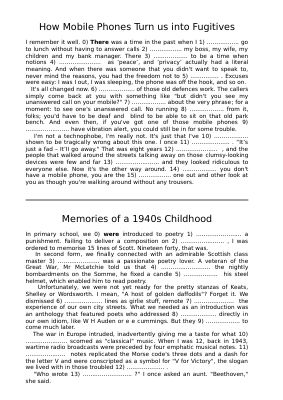
How Mobile Phones Turn us into Fugitives
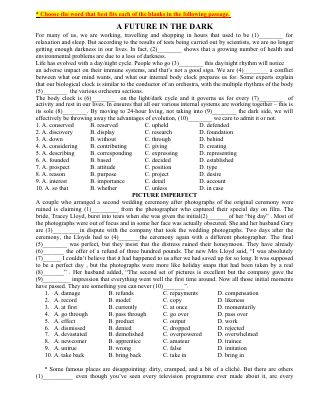
I remember it well. 0) There was a time in the past when I 1) …………….. go to lunch without having to answer calls 2) …………….. my boss, my wife, my children and my bank manager. There 3) ……………… to be a time when notions 4) …………………. as ‘peace’, and ‘privacy’ actually had a literal meaning. And when there was someone that you didn't want to speak to, never mind the reasons, you had the freedom not to 5) …………… . Excuses were easy: I was I out, I was sleeping, the phone was off the hook, and so on. It's all changed now. 6) ………………. of those old defences work. The callers simply come back at you with something like "but didn't you see my unanswered call on your mobile?" 7) ……………… about the very phrase; for a moment: to see one's unanswered call. No running 8) ……………… from it, folks; you'd have to be deaf and blind to be able to sit on that old park bench. And even then, if you've got one of those mobile phones 9) ………………….. have vibration alert, you could still be in for some trouble. I'm not a technophobe, I'm really not. It's just that I've 10) ……………… shown to be tragically wrong about this one. I once 11) ……………….. . “It’s just a fad – It’II go away." That was eight years 12) …………………. , and the people that walked around the streets talking away on those clumsy-looking devices were few and far 13) ………………….. and they looked ridiculous to everyone else. Now it's the other way around. 14) ……………… you don't have a mobile phone, you are the 15) …………….. one out and other look at you as though you're walking around without any trousers.
Memories of a 1940s Childhood
In primary school, we 0) were introduced to poetry 1) …………………… a punishment. Failing to deliver a composition on 2) ………………….. , I was ordered to memorise 15 lines of Scott. Nineteen forty, that was. In second form, we finally connected with an admirable Scottish class master 3) …………………. was a passionate poetry lover. A veteran of the Great War, Mr McLetchie told us that 4) …………………….. the nightly bombardments on the Somme, he fixed a candle 5) ……………… his steel helmet, which enabled him to read poetry. Unfortunately, we were not yet ready for the pretty stanzas of Keats, Shelley or Wordsworth. I mean, "A host of golden daffodils"? Forget it. We dismissed 6) ……………….. lines as girlie stuff, remote 7) ………………… the experience of our own city streets. What we needed as an introduction was an anthology that featured poets who addressed 8) ………………. directly in our own idiom, like W H Auden or e e cummings. But they 9) ……………… to come much later. The war in Europe intruded, inadvertently giving me a taste for what 10) …………………. scorned as "classical" music. When I was 12, back in 1943, wartime radio broadcasts were preceded by four emphatic musical notes. 11) ………………… notes replicated the Morse code's three dots and a dash for the letter V and were conscripted as a symbol for "V for Victory", the slogan we lived with in those troubled 12) ……………….. . "Who wrote 13) …………………….. ?" I once asked an aunt. "Beethoven," she said.
Trên đây là phần đầu tài liệu — bấm Đọc sách để xem đầy đủ.