
Xem trước nội dung
OPEN CLOSE
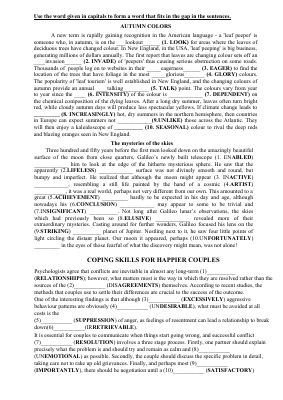
1. Bilbao
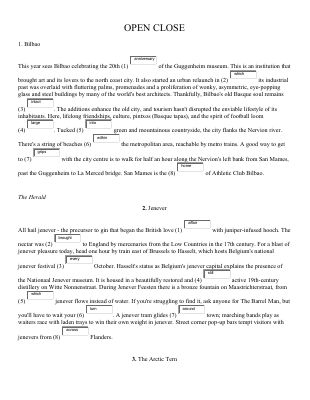
This year sees Bilbao celebrating the 20th (1) of the Guggenheim museum. This is an institution that
brought art and its lovers to the north coast city. It also started an urban relaunch in (2) its industrial past was overlaid with fluttering palms, promenades and a proliferation of wonky, asymmetric, eye-popping glass and steel buildings by many of the world's best architects. Thankfully, Bilbao's old Basque soul remains
(3) . The additions enhance the old city, and tourism hasn't disrupted the enviable lifestyle of its inhabitants. Here, lifelong friendships, culture, pintxos (Basque tapas), and the spirit of football loom
(4) . Tucked (5) green and mountainous countryside, the city flanks the Nervion river.
There's a string of beaches (6) the metropolitan area, reachable by metro trains. A good way to get
to (7) with the city centre is to walk for half an hour along the Nervion's left bank from San Mames,
past the Guggenheim to La Merced bridge. San Mames is the (8) of Athletic Club Bilbao.
The Herald
2. Jenever
All hail jenever - the precursor to gin that began the British love (1) with juniper-infused hooch. The
nectar was (2) to England by mercenaries from the Low Countries in the 17th century. For a blast of jenever pleasure today, head one hour by train east of Brussels to Hasselt, which hosts Belgium's national
jenever festival (3) October. Hasselt's status as Belgium's jenever capital explains the presence of
the Nationaal Jenever museum. It is housed in a beautifully restored and (4) active 19th-century distillery on Witte Nonnenstraat. During Jenever Feesten there is a bronze fountain on Maastrichterstraat, from
(5) jenever flows instead of water. If you're struggling to find it, ask anyone for The Barrel Man, but
you'll have to wait your (6) . A jenever tram glides (7) town; marching bands play as waiters race with laden trays to win their own weight in jenever. Street corner pop-up bars tempt visitors with
jenevers from (8) Flanders.
3. The Arctic Tern
anniversary
which
intact
large into
within
grips
home
affair
brought
every
still
which
turn around
across
The arctic tern is a water-loving bird that hatches during summer in the Arctic, the northernmost (1) of the Northern Hemisphere. During the unbearably cold, dark arctic winter, the arctic tern flies south,
following the summer season all the way to the Antarctic (2) on the other side of the Earth. Because
arctic terns do not fly in a straight line, the (3) they fly every year is even longer than the
approximately 30,000-kilometer from pole to pole. This (4) the arctic tern's migration one of the
longest of any animal on Earth. Like a lot of other birds, fish is (5) arctic terns eat. They catch fish
by gliding (6) the ocean, then plunging their feet or beaks in the water to skim fish near the surface.
Rarely, arctic terns will snatch flies or (7) insects out of the air, but they prefer fish and other marine
creatures, such as shrimp. Arctic terns have beaks and webbed feet, both of (8) are almost the same shade of tomato-red. They have gray-white bodies and a head of jet-black feathers, which looks almost like a baseball cap.
4. Tangier Island
A three-mile-long fishhook-shaped piece of land in the middle of Chesapeake Bay, Tangier Island has always
been a community set (1) from the mainland. Some people believe that Tangier is an island on
(2) people have lived since 1686. Probably the most striking example of their heritage is the
islanders' unique (3) of speaking. What stands (4) most about Tangier residents' speech
is their unusual pronunciation of common English words. Their (5) of words and expressions are only understood by islanders. In addition, residents employ a curious way of communicating that they
(6) to as talking backwards. Some writers and scholars have said the natives of Tangier speak an old
form of English that goes (7) to the time of Queen Elizabeth I. They have a lot of …
Trên đây là phần đầu tài liệu — bấm Đọc sách để xem đầy đủ.