
Xem trước nội dung
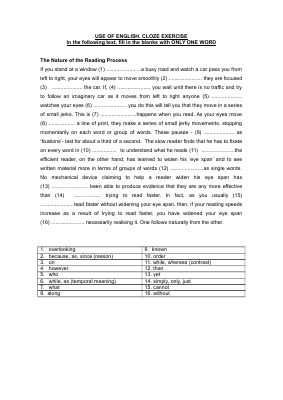
USE OF ENGLISH. CLOZE EXERCISE In the following text, fill in the blanks with ONLY ONE WORD
The Nature of the Reading Process
If you stand at a window (1) ........................a busy road and watch a car pass you from
left to right, your eyes will appear to move smoothly (2) ....................... they are focused
(3) ..................... the car. If, (4) ......................, you wait until there is no traffic and try
to follow an imaginary car as it moves from left to right anyone (5) .....................
watches your eyes (6) ....................... you do this will tell you that they move in a series
of small jerks. This is (7) .........................happens when you read. As your eyes move
(8) .................. a line of print, they make a series of small jerky movements, stopping
momentarily on each word or group of words. These pauses - (9) ..................... as
‘fixations’- last for about a third of a second. The slow reader finds that he has to fixate
on every word in (10) ................. to understand what he reads (11) .......................the
efficient reader, on the other hand, has learned to widen his ‘eye span’ and to see
written material more in terms of groups of words (12) .......................as single words.
No mechanical device claiming to help a reader widen his eye span has
(13) ......................... been able to produce evidence that they are any more effective
than (14) ................... trying to read faster. In fact, as you usually (15)
.......................read faster without widening your eye span, then, if your reading speeds
increase as a result of trying to read faster, you have widened your eye span
(16) ....................... necessarily realising it. One follows naturally from the other.
1. overlooking 9. known 2. because, as, since (reason) 10. order 3. on 11. while, whereas (contrast) 4. however 12. than 5. who 13. yet 6. while, as (temporal meaning) 14. simply, only, just 7. what 15. cannot 8. along 16. without
It's never (1) ……………….. to formally disallow an ism. It must also be made "uncool."
(2) ……………..…. our motivation behind the desire to hold others down is
psychological, social, or economic, is beside the point. Typically, a mixture of motives is
at ………….. But it's the willingness to indignify others, and the fact that we are still
collectively (4) ……………. our tongues--as previous generations did about racism--
that (5) ………………. at the root of the problems that vex us today.
I envisage a dignitarian society, one in (6) …………….. every person, regardless of
rank, expects and enjoys equal dignity. The implications of a politics (7) …………. on
the principle of dignity for all are profound. (8) ………………… as our institutions had to
be reshaped as America turned from a segregated into multicultural society, so too (9)
……….……….. we need to transform our schools, businesses, healthcare and religious
institutions as we become a dignitarian society. A dignitarian society is democracy's
(10) …………….. natural evolutionary step.
Senator Obama is at risk of (11) ………..…….. expectations beyond anyone's capacity
to deliver on them. There are no quick fixes (12) ………………. our current problems.
But (13) …………….. the public understand that building a dignitarian society is as
complex and rewarding (14) ……………….. task as overcoming racism, it may grant
our leaders, (15) ………………. they be, the patience and commitment that they are
going to need to do so.
1. enough 9. will 2. whether 10. next 3. stake 11. raising 4. holding 12. to 5. lies 13. should 6. which 14. a 7. predicated/built/based 15. whoever 8. just
Trên đây là phần đầu tài liệu — bấm Đọc sách để xem đầy đủ.