
CAE - Use of English - 5 tests without key (17 pages) Mã A742248
Báo tài liệu không phù hợp
Xem trước nội dung
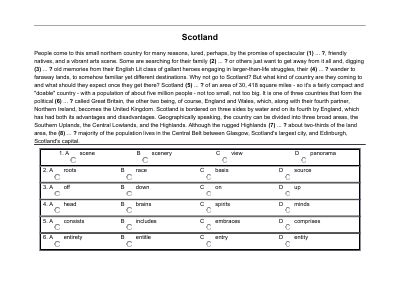
Scotland
People come to this small northern country for many reasons, lured, perhaps, by the promise of spectacular (1) ... ?, friendly natives, and a vibrant arts scene. Some are searching for their family (2) ... ? or others just want to get away from it all and, digging (3) ... ? old memories from their English Lit class of gallant heroes engaging in larger-than-life struggles, their (4) ... ? wander to faraway lands, to somehow familiar yet different destinations. Why not go to Scotland? But what kind of country are they coming to and what should they expect once they get there? Scotland (5) ... ? of an area of 30, 418 square miles - so it's a fairly compact and "doable" country - with a population of about five million people - not too small, not too big. It is one of three countries that form the political (6) ... ? called Great Britain, the other two being, of course, England and Wales, which, along with their fourth partner, Northern Ireland, becomes the United Kingdom. Scotland is bordered on three sides by water and on its fourth by England, which has had both its advantages and disadvantages. Geographically speaking, the country can be divided into three broad areas, the Southern Uplands, the Central Lowlands, and the Highlands. Although the rugged Highlands (7) ... ? about two-thirds of the land area, the (8) ... ? majority of the population lives in the Central Belt between Glasgow, Scotland's largest city, and Edinburgh, Scotland's capital.
1. A scene B scenery C view D panorama
2. A roots B race C basis D source
3. A off B down C on D up
4. A head B brains C spirits D minds
5. A consists B includes C embraces D comprises
6. A entirety B entitle C entry D entity
7. A take out B take in C take up D take off
8. A expansive B vast C expanding D spacious
The Microscope
An important invention in the development of science and medicine was the microscope. It was (1) ... ? the principle that light could be “(2) ... ?” or bent, by a glass lens. It was soon discovered that tiny objects could be magnified (3) ... ? size when viewed through a glass lens that had been ground and polished in a specific (4) ... ?. Although the principle was known to the Chinese as early as 1000 A.D, it was not until the 13th and 14th centuries in Europe (5) ... ? it was put to practical use in the form of eyeglasses. In Europe the first microscope was invented by brothers Zacharias and Hans Janssen, two Dutch eyeglass-makers, around 1590. They built a “compound” microscope, so called because of its two lenses. The most significant development and use of the microscope during this period, however, belongs to another Dutch optician, Antonie van Leeuwenhoek (1632-1723). Born in Delft, Holland, he became skilled at (6) ... ? very sharp and accurate magnifying lenses. Some of his single-lens microscopes were able to magnify up the three hundred times (7) ... ? size, and around 1660 he began serious study using these instruments. He was the first to discover bacteria and other microscopic organisms, calling these tiny creatures “animalcules”. (8) ... ? to this discovery, very small creatures such as fleas and maggots were thought to “spontaneously generate” from a single source, such as rotting meat in the case of maggots.
1. A based upon B based by C based in D based at
2. A refracted B retracted C retorted D retraced
3. A by B on C in D with
4. A procedure B manner C fashion D character
Trên đây là phần đầu tài liệu — bấm Đọc sách để xem đầy đủ.