
Xem trước nội dung
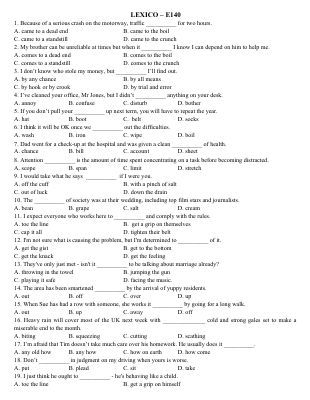
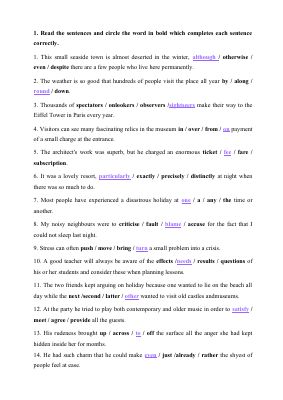
1. Read the sentences and circle the word in bold which completes each sentence
correctly.
1. This small seaside town is almost deserted in the winter, although / otherwise /
even / despite there are a few people who live here permanently.
2. The weather is so good that hundreds of people visit the place all year by / along /
round / down.
3. Thousands of spectators / onlookers / observers /sightseers make their way to the
Eiffel Tower in Paris every year.
4. Visitors can see many fascinating relics in the museum in / over / from / on payment
of a small charge at the entrance.
5. The architect's work was superb, but he charged an enormous ticket / fee / fare /
subscription.
6. It was a lovely resort, particularly / exactly / precisely / distinctly at night when
there was so much to do.
7. Most people have experienced a disastrous holiday at one / a / any / the time or
another.
8. My noisy neighbours were to criticise / fault / blame / accuse for the fact that I
could not sleep last night.
9. Stress can often push / move / bring / turn a small problem into a crisis.
10. A good teacher will always be aware of the effects /needs / results / questions of
his or her students and consider these when planning lessons.
11. The two friends kept arguing on holiday because one wanted to lie on the beach all
day while the next /second / latter / other wanted to visit old castles andmuseums.
12. At the party he tried to play both contemporary and older music in order to satisfy /
meet / agree / provide all the guests.
13. His rudeness brought up / across / to / off the surface all the anger she had kept
hidden inside her for months.
14. He had such charm that he could make even / just /already / rather the shyest of
people feel at ease.
15. Everyone in our house has their proper / single / own /only hobbies and interests.
16. He does not like talking about work when he is in / at /on / for holiday.
17. After an increase in bad behaviour, the Headteacher decided the school needed a
new set / kit / mixture /pack of rules.
18. What to watch on television often raises / causes /leads / builds arguments in our
house.
19. The weather is so bad you could be forgiven /defended / permitted / allowed for
thinking that it was winter.
20. Although / Still / However / Despite he passed his exam, he was very disappointed
with his grade.
21. "It would do / give / have / offer you good to get away for a few days."
22. He said that getting his new job was due to good luck, because he just happened to
be in the right place at
the right season / period / month / time.
23. The new video shop has a wide range of titles to choose among / with / from / out.
24. The TV stations chase / compete / oppose / pursue for the largest number of
viewers.
25. He has neglected / declined / lessened / disposed his studies and I doubt that he
will pass the exam.
2. Read the texts and decide which answer-А, Б, С or D - best fits each space (1- 15). There is an example at the beginning (0).
FRIDGE RAIDERS
People who frequently wake up in the 0) С of the night and are unable to 1)a trip to the fridge may in fact be suffering from a 2) medical complaint, say scientists. They have 3) biochemical differences in people who cannot 4) the urge to eat during the hours 5) most of us are asleep. Night Eating Syndrome, as it is called, is not a new phenomenon. In the 1950s, doctors found that 6) one and two percent of people admitted to regularly raiding their fridges at night. The new findings 7) existing evidence that the syndrome is a 8) eating disorder. 0 A centre В midpoint С middle D height 1 A avoid В stop С resist D delay 2 A legal В true С genuine D sincere 3 A invented В discovered С produced D explored 4 A control В guide С command D rule 5 A when В which С while D where 6 A about В between С around D roughly 7 A help В assist С aid D support 8 A strong В sensible С serious D strict 9 A keeping В holding С having D owning 10 A …
Trên đây là phần đầu tài liệu — bấm Đọc sách để xem đầy đủ.