
Đề ôn luyện thi học sinh giỏi THPT - PRACTICE TEST 5 (21-10-2021) có đáp án Mã A584675
Báo tài liệu không phù hợp
Xem trước nội dung
Page 1 of 14
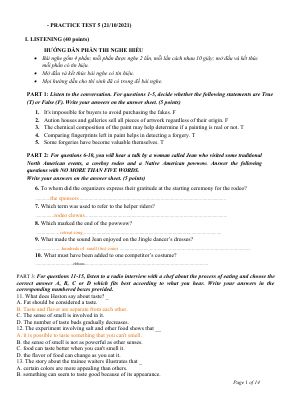
- PRACTICE TEST 5 (21/10/2021)
I. LISTENING (40 points)
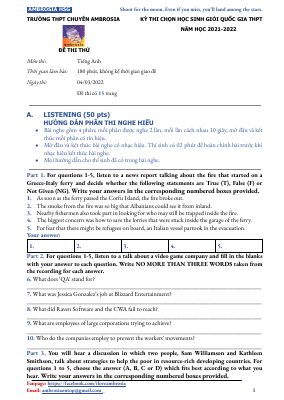
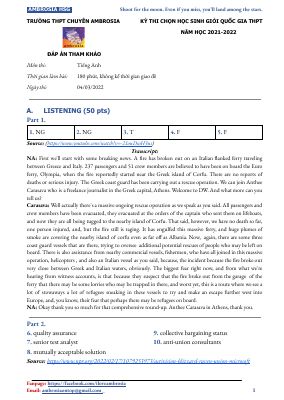
HƯỚNG DẪN PHẦN THI NGHE HIỂU Bài nghe gồm 4 phần; mỗi phần được nghe 2 lần, mỗi lần cách nhau 10 giây; mở đầu và kết thúc mỗi phần có tín hiệu. Mở đầu và kết thúc bài nghe có tín hiệu. Mọi hướng dẫn cho thí sinh đã có trong đề bài nghe.
PART 1: Listen to the conversation. For questions 1-5, decide whether the following statements are True (T) or False (F). Write your answers on the answer sheet. (5 points)
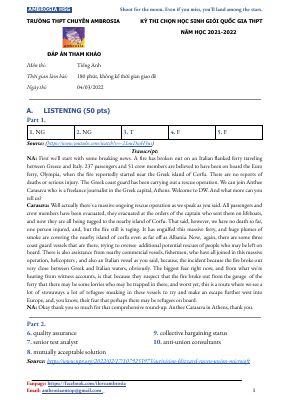
1. It's impossible for buyers to avoid purchasing the fakes. F 2. Aution houses and galleries sell all pieces of artwork regardless of their origin. F 3. The chemical composition of the paint may help determine if a painting is real or not. T 4. Comparing fingerprints left in paint helps in detecting a forgery. T 5. Some forgeries have become valuable themselves. T
PART 2: For questions 6-10, you will hear a talk by a woman called Jean who visited some traditional North American events, a cowboy rodeo and a Native American powwow. Answer the following questions with NO MORE THAN FIVE WORDS. Write your answers on the answer sheet. (5 points)
6. To whom did the organizers express their gratitude at the starting ceremony for the rodeo?
…………the sponsors ……………………………………………………………………………………………….……. 7. Which term was used to refer to the helper riders?
……………rodeo clowns…………………………………………………………………………………………….……. 8. Which marked the end of the powwow?
……………… retreat song………………………………………………………………………………………….……. 9. What made the sound Jean enjoyed on the Jingle dancer’s dresses?
…………………hundreds of small (tin) cones …………………………………………………………………………………….……. 10. What must have been added to one competitor’s costume?
…………………………ribbons……………………………………………………………………………….…….
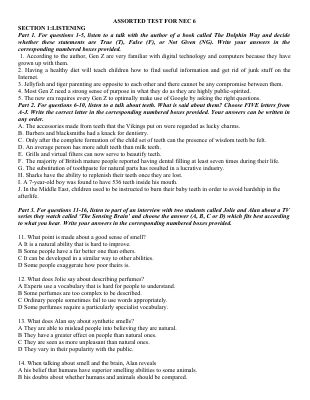
PART 3: For questions 11-15, listen to a radio interview with a chef about the process of eating and choose the correct answer A, B, C or D which fits best according to what you hear. Write your answers in the corresponding numbered boxes provided. 11. What does Heston say about taste? _ A. Fat should be considered a taste. B. Taste and flavor are separate from each other. C. The sense of smell is involved in it. D. The number of taste buds gradually decreases. 12. The experiment involving salt and other food shows that __ A. it is possible to taste something that you can't smell. B. the sense of smell is not as powerful as other senses. C. food can taste better when you can't smell it. D. the flavor of food can change as you eat it. 13. The story about the trainee waiters illustrates that _ A. certain colors are more appealing than others. B. something can seem to taste good because of its appearance.
Page 2 of 14
C. one sense can strongly influence another. D. some people can perceive taste better than others. 14. What does Heston say about bitterness?_ A. It can give a false impression that something is harmful. B. It can become the main reason why people like something. C. Reactions to it can change over time. D. Its function is widely misunderstood. 15. The problem with the dish Heston describes was caused by _ A. its appearance. B. the taste of it. C. its combination of flavors. D. the fact that people ate it repeatedly.
PART 4: You will hear a talk about climate change adaptation. For questions 16-25, complete the passage with NO MORE THAN THREE WORDS taken from the recording. Write your answers on the answer sheet. (20 points)
The International Monetary Fund (IMF) is oftentimes misperceived as the world’s fiscal sponsor, the omniscient and practically immeasurable (16)pit of money for any suffering nations. Indeed, the drive behind this organization’s assistance is likened to a (17)sugar daddy ’s, which is nothing but pressurizing the hard- hit countries to fulfill its requirements. Such a paradox can be seen in the case of Malawi in 1990s- 2000s. Besides the HIV/AIDS epidemic that was diminishing overall life expectancy and ( 18)decimating the workforce , the South East Asian country was …
Trên đây là phần đầu tài liệu — bấm Đọc sách để xem đầy đủ.