
Đề ôn luyện thi chuyên Tiếng Anh có đáp án - FURTHER PRACTICE TEST 02 (July 31st, 2021) (10 pages) Mã A432771
Báo tài liệu không phù hợp
Xem trước nội dung
FURTHER PRACTICE TEST 02 (July 31st, 2021)
I. LISTENING
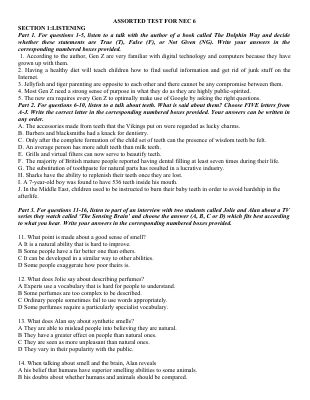
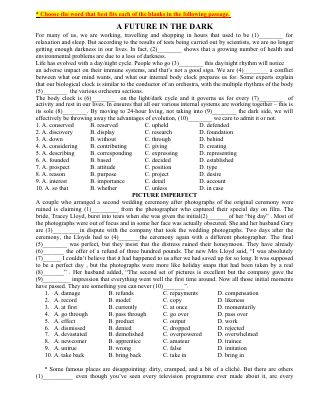
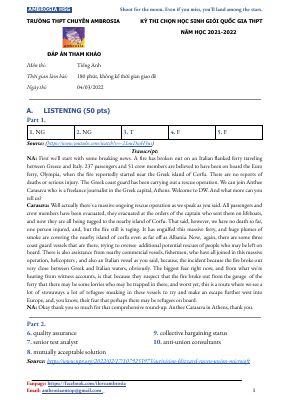
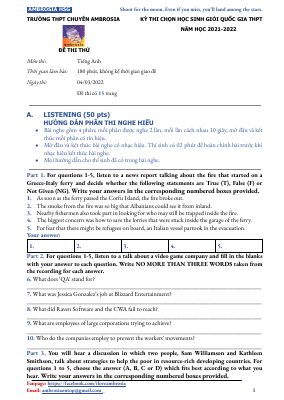
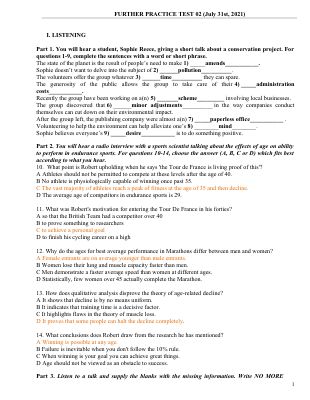
Part 1. You will hear a student, Sophie Reece, giving a short talk about a conservation project. For questions 1-9, complete the sentences with a word or short phrase. The state of the planet is the result of people’s need to make 1) _____amends___________. Sophie doesn’t want to delve into the subject of 2) ______pollution__________. The volunteers offer the group whatever 3) ______time__________ they can spare. The generosity of the public allows the group to take care of their 4) _____administration costs___________. Recently the group have been working on a(n) 5) _______scheme_________ involving local businesses. The group discovered that 6) ______minor adjustments__________ in the way companies conduct themselves can cut down on their environmental impact. After the group left, the publishing company were almost a(n) 7) _____paperless office___________ . Volunteering to help the environment can help alleviate one’s 8) ________mind________. Sophie believes everyone’s 9) _____desire___________ is to do something positive.
Part 2. You will hear a radio interview with a sports scientist talking about the effects of age on ability to perform in endurance sports. For questions 10-14, choose the answer (A, B, C or D) which fits best according to what you hear. 10. What point is Robert upholding when he says 'the Tour de France is living proof of this'? A Athletes should not be permitted to compete at these levels after the age of 40. B No athlete is physiologically capable of winning once past 35. C The vast majority of athletes reach a peak of fitness at the age of 35 and then decline. D The average age of competitors in endurance sports is 29.
11. What was Robert's motivation for entering the Tour De France in his forties? A so that the British Team had a competitor over 40 B to prove something to researchers C to achieve a personal goal D to finish his cycling career on a high
12. Why do the ages for best average performance in Marathons differ between men and women? A Female entrants are on average younger than male entrants. B Women lose their lung and muscle capacity faster than men. C Men demonstrate a faster average speed than women at different ages. D Statistically, few women over 45 actually complete the Marathon.
13. How does qualitative analysis disprove the theory of age-related decline? A It shows that decline is by no means uniform. B It indicates that training time is a decisive factor. C It highlights flaws in the theory of muscle loss. D It proves that some people can halt the decline completely.
14. What conclusions does Robert draw from the research he has mentioned? A Winning is possible at any age. B Failure is inevitable when you don't follow the 10% rule. C When winning is your goal you can achieve great things. D Age should not be viewed as an obstacle to success.
Part 3. Listen to a talk and supply the blanks with the missing information. Write NO MORE
1
THAN THREE WORDS taken from the recording for each blank. In the earliest days of human history, humans were 15)___hunter-gatherers__________, often moving from place to place in search of food People could raise food, which led to the development of 16)_____semi-permanent________ for the first time in history Steady and long term supply of food could only be guaranteed with the advent of irrigation and 17)____soil tilling_________ As trade 18)_____flourished________, so did technologies that facilitated it One reason for the high population densities in some ancient cities was that everything had to be 19)_____within walking distance________ due to unavailable transportaion During the Industrial Revolution, new technology 21)____deployed_________ on a mass scale allowed cities to expand and integrate further In the future, food production might move to 21)_____verticle farms________and skyscrapers, rooftop gardens or 22)_____vacant lots________in city centres The futue of cities is …
Trên đây là phần đầu tài liệu — bấm Đọc sách để xem đầy đủ.