
CÙNG HỌC THI HSG MÔN TIẾNG ANH KỲ THI HỌC SINH GIỎI QUỐC GIA THPT ĐỀ THI THỬ SỐ 03 NĂM 2019 Mã A217384
Báo tài liệu không phù hợp
Xem trước nội dung
1
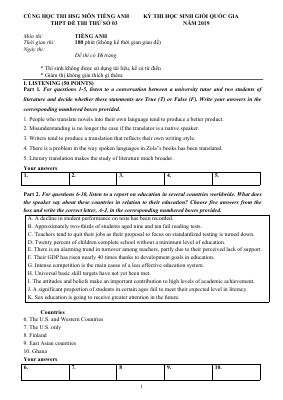
CÙNG HỌC THI HSG MÔN TIẾNG ANH KỲ THI HỌC SINH GIỎI QUỐC GIA THPT ĐỀ THI THỬ SỐ 03 NĂM 2019
Môn thi: TIẾNG ANH Thời gian thi: 180 phút (không kể thời gian giao đề) Ngày thi:
Đề thi có 16 trang
* Thí sinh không được sử dụng tài liệu, kể cả từ điển * Giám thị không giải thích gì thêm. I. LISTENING (50 POINTS) Part 1. For questions 1-5, listen to a conversation between a university tutor and two students of
literature and decide whether these statements are True (T) or False (F). Write your answers in the
corresponding numbered boxes provided.
1. People who translate novels into their own language tend to produce a better product.
2. Misunderstanding is no longer the case if the translator is a native speaker.
3. Writers tend to produce a translation that reflects their own writing style.
4. There is a problem in the way spoken languages in Zola‟s books has been translated.
5. Literary translation makes the study of literature much broader.
Your answers 1. 2. 3. 4. 5.
Part 2. For questions 6-10, listen to a report on education in several countries worldwide. What does the speaker say about these countries in relation to their education? Choose five answers from the box and write the correct letter, A-J, in the corresponding numbered boxes provided.
A. A decline in student performance on tests has been recorded. B. Approximately two-thirds of students aged nine and ten fail reading tests. C. Teachers tend to quit their jobs as their proposal to focus on standardized testing is turned down. D. Twenty percent of children complete school without a minimum level of education. E. There is an alarming trend in turnover among teachers, partly due to their perceived lack of support. F. Their GDP has risen nearly 40 times thanks to development goals in education. G. Intense competition is the main cause of a less effective education system. H. Universal basic skill targets have not yet been met. I. The attitudes and beliefs make an important contribution to high levels of academic achievement. J. A significant proportion of students in certain ages fail to meet their expected level in literacy. K. Sex education is going to receive greater attention in the future.
Countries 6. The U.S. and Western Countries 7. The U.S. only 8. Finland 9. East Asian countries 10. Ghana Your answers 6. 7. 8 9. 10.
Part 3. For questions 11-15, listen to a discussion with regard to hyperpolyglotism and choose the correct answer A, B, C, or D which fits best according to what your hear. Write your answers in the corresponding numbered boxes provided. 11. Olivia and Ron both say that their motivation for learning so many languages is
A. the possibility of communicating with people around the world. B. their fascination with language systems. C. their ability to master languages extremely quickly. D. the challenge of achieving native speaker fluency. 12. What did Ron learn about hyperpolyglots when he was researching his book?
A. They do not have any special genetic features. B. They usually have a history of multi-lingualism in the family. C. They are part of a relatively recent phenomenon. D. They usually focus on the same group of languages. 13. When discussing reactions to their hyperpolyglotism, Ron agrees with Olivia that
A. people often make the wrong assumptions about their personalities. B. it is surprising how much attention they attract. C. people cannot see the point of learning so many languages. D. it is touching how eager people are to help them. 14. How does Olivia feel about spending so much time on the internet?
A. proud of the intensity with which she studies B. defensive about the choices she makes C. worried that she is becoming isolated from her friends D. embarrassed about her enjoyment of soap operas and chat shows 15. What point does Ron make about one East Asian Language?
A. He finds it particularly appropriate in one situation. B. He hopes to keep it alive for posterity. C. It has not kept up with modern …
Trên đây là phần đầu tài liệu — bấm Đọc sách để xem đầy đủ.