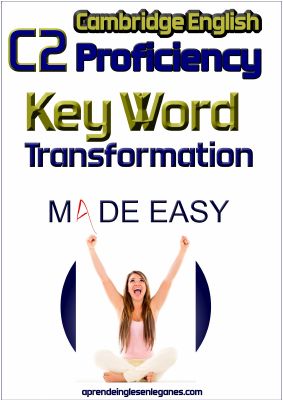

C2 Proficiency - Key Word Transformation Made Easy by Diego Mendez (Author), M.C. Curley (Editor) Mã A530960
Báo tài liệu không phù hợp
Xem trước nội dung
2
While every precaution has been taken in the preparation of this
book, the publisher assumes no responsibility for errors or
omissions, or for damages resulting from the use of the
information contained herein.
FCE KEY WORD TRANSFORMATION MADE EASY
Third edition. July 8, 2020
Copyright © 2020 D.Méndez.
Written by D.Méndez.
ISBN: 9781506678987
www.aprendeinglesenleganes.com
No part of the contents of this book may be reproduced or used in any
form or by any means without the written permission of the author, except in the case of brief quotations embodied in critical articles and
reviews
3
INTRODUCTION
The Key word transformation tests a wide range of different grammatical structures and vocabulary. You must show your ability to paraphrase using the key word and, most importantly, keeping the meaning the same.
The difficulty lies on the great variety of grammatical structures that you need to learn in order to do this part of the Use of English exam successfully.
You will be required to use structures such as passive tenses, conditional clauses, reported speech, causative verbs, inverted sentences, comparatives and superlatives, phrasal verbs, idioms, set phrases, etc. The book that you have in front of you will help you with that.
This book will help you get a better understanding of the different and most common grammatical structures , that you will have to face when completing the Key word transformation part of the Use of English exam.
As they say, practice makes perfect. The more Key word transformation exercises you do, the better you will become at doing them. What’s more, over time you will get a feel for what kind of grammatical structure or lexical item is needed for the exercise that you are doing.
To your success.
D.Méndez
4
CONTENTS.
5. HOW TO DO KEY WORD TRANSFORMATION EXERCISES 7. SENTENCES REQUIRING TWO CHANGES 8. SPECULATING ABOUT THE PRESENT 9. SPECULATING ABOUT THE PAST 10. AGO to FOR / FOR to AGO / LAST
AGO to SINCE/ SINCE to AGO - SINCE to FOR / FOR to SINCE STILL to YET / EVER to YET FIRST TIME to HAVE NEVER TOO to ENOUGH / ENOUGH to TOO 11. REPORTED SPEECH 12. ACTIVE VERB FORM to PASSIVE VERB FORM 13. INVERTED SENTENCES 15. CONDITIONAL SENTENCES 16. INVERTED CONDITIONALS 17. DEGREES OF LIKELIHOOD 18. WISHES AND PREFERENCES 20. COMPARATIVE – SUPERLATIVE 21. COMPARATIVE STRUCTURES - ADVERBS 22. CONTRAST STRUCTURES 23. SYNONYMS 28. CAUSE AND EFFECT 29. CAUSATIVE VERBS 30. PHRASAL VERBS 31. 50 COMMON PHRASAL VERBS (C2 LEVEL) 34. C2 PROFICIENCY PHRASAL VERBS (TABLE) 35. PHRASAL PREPOSITIONAL VERBS 37. VERBS FOLLOWED BY A TO-INFINITIVE 38. VERBS FOLLOWED BY GERUND (ING) 39. NEGATIVE WORDS 40. MODAL VERBS 41. PREPOSITIONAL VERBS 42. PREPOSITIONAL VERBS ( LIST) 45. VERB PATTERNS 47. INFORMAL to FORMAL / FORMAL to INFORMAL 48. LINKING WORDS 50. PARAPHRASING 54. IDIOMS 55. 50 COMMON IDIOMS (C2 LEVEL) 58. C2 PROFICIENCY IDIOMS (TABLE) 59. SET PHRASES 60. 50 MOST COMMON SET PHRASES (C2 LEVEL) 63. COMMON C2 LEVEL PHRASES (TABLE) 64. KEY WORD TRANSFORMATION - PRACTICE EXERCISES 68. ANSWERS
Trên đây là phần đầu tài liệu — bấm Đọc sách để xem đầy đủ.