
Xem trước nội dung
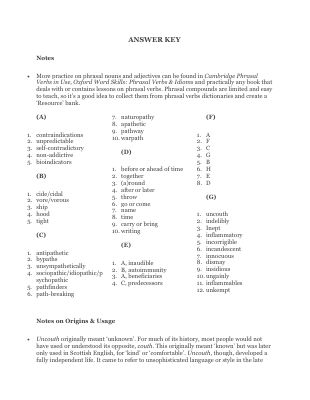
ANSWER KEY
Notes
• More practice on phrasal nouns and adjectives can be found in Cambridge Phrasal Verbs in Use, Oxford Word Skills: Phrasal Verbs & Idioms and practically any book that deals with or contains lessons on phrasal verbs. Phrasal compounds are limited and easy to teach, so it’s a good idea to collect them from phrasal verbs dictionaries and create a ‘Resource’ bank.
(A)
1. contraindications 2. unpredictable 3. self-contradictory 4. non-addictive 5. bioindicators
(B)
1. cide/cidal 2. vore/vorous 3. ship 4. hood 5. tight
(C)
1. antipathetic 2. bypaths 3. unsympathetically 4. sociopathic/idiopathic/p
sychopathic 5. pathfinders 6. path-breaking
7. naturopathy 8. apathetic 9. pathway 10. warpath
(D)
1. before or ahead of time 2. together 3. (a)round 4. after or later 5. throw 6. go or come 7. name 8. time 9. carry or bring 10. writing
(E)
1. A, inaudible 2. B, autoimmunity 3. A, beneficiaries 4. C, predecessors
(F)
1. A 2. F 3. C 4. G 5. B 6. H 7. E 8. D
(G)
1. uncouth 2. indelibly 3. Inept 4. inflammatory 5. incorrigible 6. incandescent 7. innocuous 8. dismay 9. insidious 10. ungainly 11. inflammables 12. unkempt
Notes on Origins & Usage
• Uncouth originally meant ‘unknown’. For much of its history, most people would not have used or understood its opposite, couth. This originally meant ‘known’ but was later only used in Scottish English, for ‘kind’ or ‘comfortable’. Uncouth, though, developed a fully independent life. It came to refer to unsophisticated language or style in the late
17th century, and then to uncultured or ill-mannered people or behaviour. In 1896 the English essayist and critic Max Beerbohm (1872–1956) was the first to use couth as a deliberate opposite of uncouth meaning ‘cultured, well-mannered’. • Ungainly developed in a similar way. There is a word gainly, but it has never been common and its original meaning, ‘suitable, fitting’, now occurs only in Scottish dialect. Gainly came from the old word gain, which was used especially in the senses ‘kindly’ and ‘convenient’, and is of Scandinavian origin. • The words inflammable and flammable both have the same meaning, ‘easily set on fire’. This might seem surprising, given that the prefix in- normally has a negative meaning (as in indirect and insufficient), and so it might be expected that inflammable would mean the opposite of flammable, i.e. ‘not easily set on fire’. In fact, inflammable is formed using a different Latin prefix in-, which has the meaning ‘into’ and here has the effect of intensifying the meaning of the word in English (also as in incandescent). Flammable is a far commoner word than inflammable and carries less risk of confusion. • People have only combed their hair since around 1400; before that they would have kembed it and their hair would have been kempt. These are forms of the old word kemb, which was eventually replaced by the related word comb, an Old English word which may have the underlying sense of ‘tooth’. The term has survived, though, sometimes in the form kempt but especially in unkempt, which has come to mean ‘untidy or dishevelled’ rather than ‘uncombed’.
(H)
1. bespectacled 2. bioprospecting 3. disrespectful 4. introspective 5. multispectral 6. perspective 7. irrespective 8. retrospect 9. self-respecting 10. unsuspectedly
Teaching Tips
• You may also want to ask your students to answer the following question: (6+) His book is an engaging and __________ exploration of the many facets, in Britain and abroad, of the old amateur game. (PERSPECTIVE) • Answer: perspicacious • In early use perspective was a name for the science of optics: it comes from medieval Latin perspectiva (ars) ‘science of optics’, from perspicere ‘look at closely’. The notion of perspective in drawings dates from the end of the 16th century. The same verb lies behind perspicacious (early 17th century) which comes from the Latin for ‘seeing clearly’.
Trên đây là phần đầu tài liệu — bấm Đọc sách để xem đầy đủ.