
WORD FORMATION EXERCISES (đươc sưu tâm tư đê thi thư cua cac trương chuyên trên cả nước) dùng luyện thi Chuyên Tiếng Anh khó Mã A259994
Báo tài liệu không phù hợp
Xem trước nội dung
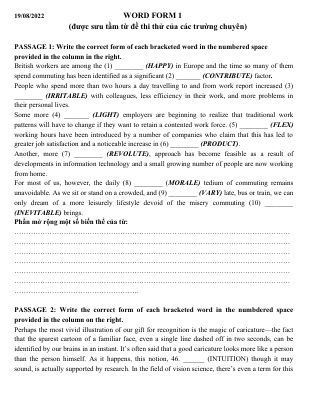
19/08/2022 WORD FORM 1 (được sưu tầm từ đề thi thử của các trường chuyên)
PASSAGE 1: Write the correct form of each bracketed word in the numbered space provided in the column in the right. British workers are among the (1) ________ (HAPPY) in Europe and the time so many of them spend commuting has been identified as a significant (2) _______ (CONTRIBUTE) factor. People who spend more than two hours a day travelling to and from work report increased (3) ________ (IRRITABLE) with colleagues, less efficiency in their work, and more problems in their personal lives. Some more (4) _______ (LIGHT) employers are beginning to realize that traditional work patterns will have to change if they want to retain a contented work force. (5) ________ (FLEX) working hours have been introduced by a number of companies who claim that this has led to greater job satisfaction and a noticeable increase in (6) ________ (PRODUCT). Another, more (7) ________ (REVOLUTE), approach has become feasible as a result of developments in information technology and a small growing number of people are now working from home. For most of us, however, the daily (8) ________ (MORALE) tedium of commuting remains unavoidable. As we sit or stand on a crowded, and (9) ________ (VARY) late, bus or train, we can only dream of a more leisurely lifestyle devoid of the misery commuting (10) ________ (INEVITABLE) brings. Phần mở rộng một số biến thể của từ: ……………………………………………………………………………………………………… ……………………………………………………………………………………………………… ……………………………………………………………………………………………………… ……………………………………………………………………………………………………… ……………………………………………………………………………………………………… ……………………………………………………………………………………………………… ……………………………………………..
PASSAGE 2: Write the correct form of each bracketed word in the numbdered space provided in the column on the right. Perhaps the most vivid illustration of our gift for recognition is the magic of caricature—the fact that the sparest cartoon of a familiar face, even a single line dashed off in two seconds, can be identified by our brains in an instant. It’s often said that a good caricature looks more like a person than the person himself. As it happens, this notion, 46. ______ (INTUITION) though it may sound, is actually supported by research. In the field of vision science, there’s even a term for this
seeming paradox—the caricature effect—a phrase that hints at how our brains 47. ______ (PERCEPTION) faces as much as perceive them. Human faces are all built pretty much the same: two eyes above a nose that’s above a mouth, the features 48. ______ (VARIETY) from person to person generally by mere millimeters. So what our brains look for, according to vision scientists, are the 49. ______ (LIE) features—those 50. ______ (CHARACTER) that deviate most from the ideal face we carry around in our heads, the running average of every visage we’ve ever seen. We code each new face we encounter not in absolute terms but in the several ways it differs 51. ______ (MARK) from the mean. In other words, to beat what vision scientists call the 52. ______ (HOMOGENEOUS) problem, we 53. ______ (ACCENT) what’s most important for recognition and largely ignore what isn’t. Our perception fixates on the 54. ______ (TURN) nose, rendering it more porcine, the sunken eyes or the 55. ______ (FLESH) cheeks, making them loom larger. To better identify and remember people, we turn them into caricatures. Phần mở rộng một số biến thể của từ: ……………………………………………………………………………………………………… ……………………………………………………………………………………………………… ……………………………………………………………………………………………………… ……………………………………………………………………………………………………… ……………………………………………………………………………………………………… ……………………………………………………………………………………………………… ……………………………………………..
PASSAGE 3. Supply the correct form of the verbs in block capitals in brackets to complete the passage.
The (1. assert) __________ that mathematics has been a major force in the of modern culture appears to many people (2. credible) __________or, at best, a rank exaggeration. …
Trên đây là phần đầu tài liệu — bấm Đọc sách để xem đầy đủ.