


Xem trước nội dung
IELTS READING TIPS
Collected by Ly Na Tran Resources: ielts-simon.com https://www.facebook.com/tuhocIelts8.0 Page 1
1. IELTS Academic Reading: Basic Information
The Reading Test is immediately after the Listening Test at 10.40am. You do not get a break.
There are 3 sections in the Reading Test. Each section has 13 or 14 questions, making 40 questions in total. The test lasts 60 minutes, and in that time you must write your answers on an answer sheet.
Here are some of the problems students have with IELTS Reading:
Time is the biggest problem. Many students don't manage to finish the test.
The texts are long and contain some difficult vocabulary.
Students find "paragraph headings" questions difficult.
Students find "true/ false/ not given" questions difficult.
IELTS Reading is really a test of your vocabulary. If your knowledge of English words and phrases is good, you will do well.
There are techniques that can help you to work faster and cope with the difficult question types. However, the best way to improve your IELTS Reading score is by doing a lot of reading and vocabulary work.
IELTS READING TIPS
Collected by Ly Na Tran Resources: ielts-simon.com https://www.facebook.com/tuhocIelts8.0 Page 2
2. ELTS Reading: Simon’s advices
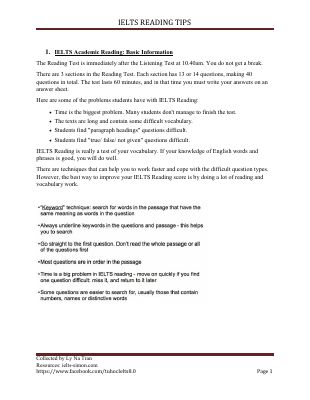
1. Don't read the whole text; you haven't got enough time. Just go straight to the questions.
2. 'Paragraph' questions are much easier if you do them last. Do other sections first.
3. The answers to most questions should be in the correct order in the text, so you don't
need to go back to the beginning to start looking for the next answer.
4. Read all instructions carefully.
5. Look for 'keywords'. There are usually words in the questions that are similar to words
you need to find in the text. For example, if the text contains the word "global", the question might use the word "international". If you find the similar words, you have probably found the answer.
6. You must get to the end and answer every question. If you don't finish, you might miss
some easy points.
7. Some questions are difficult because their aim is to separate band 8 and band 9. Don't
waste time on difficult questions. Miss them, finish the exam, and return to them at the end.
3. IELTS Reading: some suggestions
People often ask me for advice about how to improve their reading. Here are some suggestions:
1. If you want to improve your reading, the first thing to do is read a lot. There are no
shortcuts or secret techniques; you will only improve with time and practice.
2. Anything you read in English is good practice, so read about subjects that interest you.
Try to enjoy reading in English.
3. English is the most used language on the web. Whenever you search for information on
the Internet, try searching in English first.
4. Remember that "understanding is not the same as using". Keep a notebook with useful
words and phrases that you find when you're reading, and try using them in your own sentences.
5. Apart from reading things that interest you, you also need to read lots of IELTS
passages. If you've done all of the tests in the Cambridge books, read the passages again without doing the questions. Use a dictionary, take notes, and try to fully understand each passage.
6. Another way to use the Cambridge tests is to look at the correct answers to each
question first. Your task is to find out why those answers are correct by analysing the passage carefully and finding the 'keywords'.
Trên đây là phần đầu tài liệu — bấm Đọc sách để xem đầy đủ.










