


Xem trước nội dung
IELTS Reading Strategies Summarized
Reading is a test of two skills:
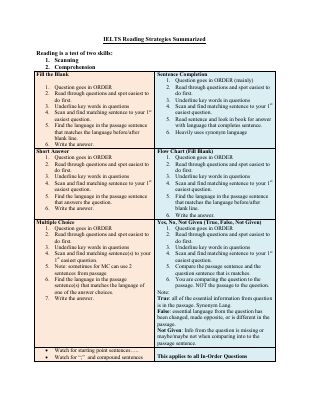
1. Scanning 2. Comprehension Fill the Blank
1. Question goes in ORDER 2. Read through questions and spot easiest to
do first. 3. Underline key words in questions 4. Scan and find matching sentence to your 1st
easiest question. 5. Find the language in the passage sentence
that matches the language before/after blank line. 6. Write the answer.
Sentence Completion
1. Question goes in ORDER (mainly) 2. Read through questions and spot easiest to
do first. 3. Underline key words in questions 4. Scan and find matching sentence to your 1st
easiest question. 5. Read sentence and look in book for answer
with language that completes sentence. 6. Heavily uses synonym language
Short Answer
1. Question goes in ORDER 2. Read through questions and spot easiest to
do first. 3. Underline key words in questions 4. Scan and find matching sentence to your 1st
easiest question. 5. Find the language in the passage sentence
that answers the question. 6. Write the answer.
Flow Chart (Fill Blank)
1. Question goes in ORDER 2. Read through questions and spot easiest to
do first. 3. Underline key words in questions 4. Scan and find matching sentence to your 1st
easiest question. 5. Find the language in the passage sentence
that matches the language before/after blank line. 6. Write the answer. Multiple Choice
1. Question goes in ORDER 2. Read through questions and spot easiest to
do first. 3. Underline key words in questions 4. Scan and find matching sentence(s) to your
1st easiest question. 5. Note: sometimes for MC can use 2
sentences from passage 6. Find the language in the passage
sentence(s) that matches the language of one of the answer choices. 7. Write the answer.
Yes, No, Not Given (True, False, Not Given)
1. Question goes in ORDER 2. Read through questions and spot easiest to
do first. 3. Underline key words in questions 4. Scan and find matching sentence to your 1st
easiest question. 5. Compare the passage sentence and the
question sentence that is matches. 6. You are comparing the question to the
passage. NOT the passage to the question. Note: True: all of the essential information from question is in the passage. Synonym Lang. False: essential language from the question has been changed, made opposite, or is different in the passage. Not Given: Info from the question is missing or maybe/maybe not when comparing into to the passage sentence. Watch for starting point sentences….. Watch for “;” and compound sentences
This applies to all In-Order Questions
Summary Question
1. Basically is a Fill Blank Question 2. Difference: Sentences can come from
multiple paragraphs. 3. Difference: most of the time in order 4. Read through questions and spot easiest to
do first. 5. Underline key words in questions 6. Scan and find matching sentence to your 1st
easiest question. 7. Find the language in the passage sentence
that matches the language before/after blank line. 8. Write the answer.
Paragraph Location Question
1. DO LAST if in a set. For general exam
mainly in passage 3. 2. Underline keywords in question statement. 3. Pay attention to Topic Sentences as very
often these point to if that paragraph has that question statement information. 4. Question can be time consuming, which is
why you should do other questions first so you can see a lot of the passage. 5. Note: underline the keywords before
moving on to other questions.
Matching Question
1. Note if instructions say name in box can be
used more than once. 2. Note: some names can appear more than
once in a passage. 3. Locate names in passage. 4. Do the names that only appear once first. 5. Read the sentence where you see
name….look for what said or position of person. 6. Look at sentences and see which one the
information in passage for that person matches. 7. Synonym Language
Which section are the following statements true for? Classification Question. (General)
1. Basically …
Trên đây là phần đầu tài liệu — bấm Đọc sách để xem đầy đủ.










