


Xem trước nội dung
ielts-simon.com: IELTS Reading
http://ielts-simon.com/ielts-help-and-english-pr/ielts-reading/[13-08-11 21.37.47]
ielts-simon.com
Daily Lessons with Simon, ex-IELTS examiner
W e b s i t e s
ielts-simon home
IELTS in Manchester
ielts-simon on facebook
I n f o r m a t i o n
About IELTS-Simon
Recent Exam Questions
Simon's IELTS eBook
E x t r a m a t e r i a l s
Simon's ebook
C a t e g o r i e s
About the exam
IELTS Listening
IELTS Reading
IELTS Speaking
IELTS Writing Task 1
IELTS Writing Task 2
Mistakes/Grammar
Questions/Advice
S e a r c h
Subscribe to this blog's feed
A r c h i v e s
August 2011
July 2011
June 2011
May 2011
April 2011
March 2011
February 2011
Monday, August 08, 2011
Monday, August 01, 2011
IELTS Reading: 'keyword' technique
What do I mean by the 'keyword' technique?
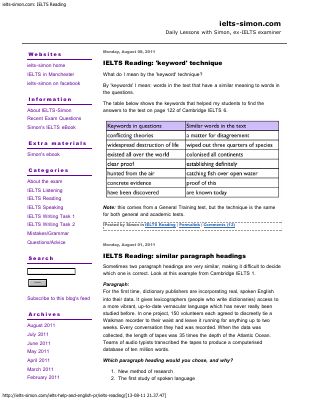
By 'keywords' I mean: words in the text that have a similar meaning to words in the questions.
The table below shows the keywords that helped my students to find the answers to the test on page 122 of Cambridge IELTS 6.
Note: this comes from a General Training test, but the technique is the same for both general and academic tests.
Posted by Simon in IELTS Reading | Permalink | Comments (12)
IELTS Reading: similar paragraph headings
Sometimes two paragraph headings are very similar, making it difficult to decide which one is correct. Look at this example from Cambridge IELTS 1.
Paragraph: For the first time, dictionary publishers are incorporating real, spoken English into their data. It gives lexicographers (people who write dictionaries) access to a more vibrant, up-to-date vernacular language which has never really been studied before. In one project, 150 volunteers each agreed to discreetly tie a Walkman recorder to their waist and leave it running for anything up to two weeks. Every conversation they had was recorded. When the data was collected, the length of tapes was 35 times the depth of the Atlantic Ocean. Teams of audio typists transcribed the tapes to produce a computerised database of ten million words.
Which paragraph heading would you chose, and why?
1. New method of research 2. The first study of spoken language
Search
ielts-simon.com: IELTS Reading
http://ielts-simon.com/ielts-help-and-english-pr/ielts-reading/[13-08-11 21.37.47]
January 2011
December 2010
November 2010
Monday, July 25, 2011
Monday, July 18, 2011
Feel free to discuss this question in the "comments" area below this lesson. I'll give you my answer and explanation tomorrow.
Posted by Simon in IELTS Reading | Permalink | Comments (43)
IELTS Reading: paragraph headings
Read the following passage about a chess-playing computer.
A) On February 10, 1996, Deep Blue became the first machine to win a chess game against a reigning world champion (Garry Kasparov) under regular time controls. However, Kasparov won three and drew two of the following five games, beating Deep Blue by a score of 4–2. Deep Blue was then heavily upgraded and played Kasparov again in May 1997, winning the six-game rematch 3½–2½. Deep Blue won the deciding game six, becoming the first computer system to defeat a reigning world champion in a match under standard chess tournament time controls.
B) After the loss, Kasparov said that he sometimes saw deep intelligence and creativity in the machine's moves, suggesting that during the second game, human chess players had intervened on behalf of the machine, which would be a violation of the rules. IBM denied that it cheated, saying the only human intervention occurred between games. The rules provided for the developers to modify the program between games, an opportunity they said they used to shore up weaknesses in the computer's play that were revealed during the course of the match. This allowed the computer to avoid a trap in the final game that it had fallen for twice before. Kasparov demanded a rematch, but IBM refused and dismantled Deep Blue.
Choose the best heading for paragraphs A and B …
Trên đây là phần đầu tài liệu — bấm Đọc sách để xem đầy đủ.










