


(ZIM) INTENSIVE COURSE GENERAL TRAINING MATERIAL WRITING TASK 1 SUPPLEMENT LESSON - How to write general complaint letter
Báo tài liệu không phù hợp
Xem trước nội dung
INTENSIVE COURSE
GENERAL TRAINING MATERIAL
WRITING TASK 1 – SUPPLEMENT LESSON
UNDERSTANDING THE TASK 1 QUESTION
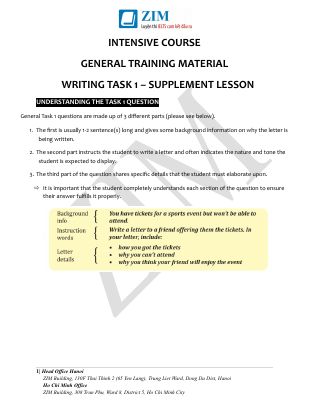
General Task 1 questions are made up of 3 different parts (please see below).
1. The first is usually 1-2 sentence(s) long and gives some background information on why the letter is
being written.
2. The second part instructs the student to write a letter and often indicates the nature and tone the
student is expected to display.
3. The third part of the question shares specific details that the student must elaborate upon.
It is important that the student completely understands each section of the question to ensure
their answer fulfills it properly.
1| Head Office Hanoi
ZIM Building, 130F Thai Thinh 2 (65 Yen Lang), Trung Liet Ward, Dong Da Dist, Hanoi Ho Chi Minh Office ZIM Building, 308 Tran Phu, Ward 8, District 5, Ho Chi Minh City
FORMAL AND INFORMAL
1. The most significant differences between 2 tones lie in opening part and ending parts of the letter.
2. The next noticeable distinction between these tones is the content of its first and last paragraphs.
Formal Informal
The first paragraph should be short and state the purpose of the letter- to make an enquiry, complain, request something, etc.
The first paragraph should be a warm greeting, which most likely asks about the situation of the receiver and shows some of your regards.
The last paragraph of a formal letter should state what action you expect the recipient to take- to refund, send you information, etc.
3. The rest of the work to differentiate the tone will depend on how you use vocabulary and grammar.
1| Head Office Hanoi
ZIM Building, 130F Thai Thinh 2 (65 Yen Lang), Trung Liet Ward, Dong Da Dist, Hanoi Ho Chi Minh Office ZIM Building, 308 Tran Phu, Ward 8, District 5, Ho Chi Minh City
LETTER STUCTURE EXPLAINED
Although the purpose and tone of your IELTS letter may vary, the structure you will follow will not. Because letters address their reader directly, they are structured in a manner that allows them to be extremely concise without sacrificing courtesy.
A complete letter has five parts. You should skip a line between each to ensure it is clear where one part finishes and another begins. The five parts of a letter are
1. The salutation is the greeting portion of the letter. On the IELTS exam, this portion will be written for you. Common salutations you will see on your exam are:
2. The statement of purpose is the short paragraph that you will write to tell your reader why you are writing. This section is typically only 1 or 2 sentences long.
3. The situational details paragraph is the portion of the letter where you will expand and explain the particulars of your position to your reader.
4. The statement of request is the part of the letter where you declare what you hope will be accomplished as a result of your writing.
5. The farewell is the few words you write to close your letter. Tailoring your farewell to the subject of your letter is an additional way to demonstrate your lexical abilities in English to your examiner. Some example farewells are:
1| Head Office Hanoi
ZIM Building, 130F Thai Thinh 2 (65 Yen Lang), Trung Liet Ward, Dong Da Dist, Hanoi Ho Chi Minh Office ZIM Building, 308 Tran Phu, Ward 8, District 5, Ho Chi Minh City
Trên đây là phần đầu tài liệu — bấm Đọc sách để xem đầy đủ.










