


Xem trước nội dung
SỞ GD&ĐT BÀ RỊA VŨNG TÀU LIÊN TRƯỜNG THPT TP VŨNG TÀU
(Đề thi có 06 trang)
KỲ THI THỬ TỐT NGHIỆP THPT NĂM 2021 – LẦN 2
Bài thi: NGOẠI NGỮ, Môn thi: TIẾNG ANH Thời gian làm bài: 60 phút, không kể thời gian phát đề
Họ, tên thí sinh: ……………………………….. Số báo danh: ………………………………..
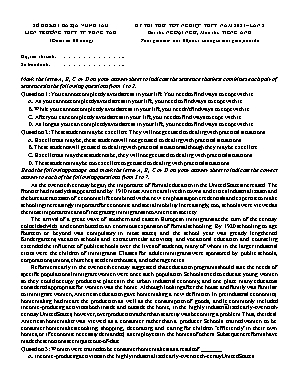
Mark the letter A, B, C or D on your answer sheet to indicate the sentence that best combines each pair of sentences in the following questions from 1 to 2. Question 1: You cannot completely avoid stress in your life. You need to find ways to cope with it.
A. As you cannot completely avoid stress in your life, you need to find ways to cope with it. B. While you cannot completely avoid stress in your life, you needn't find ways to cope with it. C. After you can completely avoid stress in your life, you need to find ways to cope with it. D. As long as you can completely avoid stress in your life, you need to find ways to cope with it. Question 2: These students may be excellent. They will not get used to dealing with practical situations.
A. Excellent as may be, these students will not get used to dealing with practical situations. B. These students will get used to dealing with practical situations although they may be excellent. C. Excellent as may these students be, they will not get used to dealing with practical situations. D. These students may be too excellent to get used to dealing with practical situations. Read the following passage and mark the letter A, B, C or D on your answer sheet to indicate the correct answer to each of the following questions from 3 to 7.
As the twentieth century began, the importance of formal education in the United States increased. The frontier had mostly disappeared and by 1910 most Americans lived in towns and cities. Industrialization and the bureaucratization of economic life combined with a new emphasis upon credentials and expertise to make schooling increasingly important for economic and social mobility. Increasingly, too, schools were viewed as the most important means of integrating immigrants into American society.
The arrival of a great wave of southern and eastern European immigrants at the turn of the century coincided with and contributed to an enormous expansion of formal schooling. By 1920 schooling to age fourteen or beyond was compulsory in most states, and the school year was greatly lengthened. Kindergartens, vacation schools and extracurricular activities, and vocational education and counseling extended the influence of public schools over the lives of students, many of whom in the larger industrial cities were the children of immigrants. Classes for adult immigrants were sponsored by public schools, corporations, unions, churches, settlement houses, and other agencies.
Reformers early in the twentieth century suggested that education programs should suit the needs of specific populations. Immigrant women were once such population. Schools tried to educate young women so they could occupy productive places in the urban industrial economy, and one place many educators considered appropriate for women was the home. Although looking after the house and family was familiar to immigrant women, American education gave homemaking a new definition. In preindustrial economies, homemaking had meant the production as well as the consumption of goods, and it commonly included income-producing activities both inside and outside the home, in the highly industrialized early-twentieth- century United States, however, overproduction rather than scarcity was becoming a problem. Thus, the ideal American homemaker was viewed as a consumer rather than a producer. Schools trained women to be consumer homemakers cooking, shopping, decorating, and caring for children "efficiently" in their own homes, or if economic necessity demanded, as employees in the homes of others. Subsequent reforms have made these notions seem quite out-of-date. Question 3: Women were trained to be consumer homemakers as a result of …
Trên đây là phần đầu tài liệu — bấm Đọc sách để xem đầy đủ.

.jpg "Bộ đề thi thử môn Tiếng Anh THPT 2026 mới nhất (Có lời giải)")




 file word Co Dap An.jpg "Đề thi thử Tốt nghiệp THPT 2026 Tiếng Anh Bắc Giang (Form Mới) file word Có Đáp Án")

.jpg "Đề Thi Thử Tốt Nghiệp THPT 2026 Tiếng Anh THPT Yên Dũng 2, Bắc Ninh (Có Đáp Án)")
