

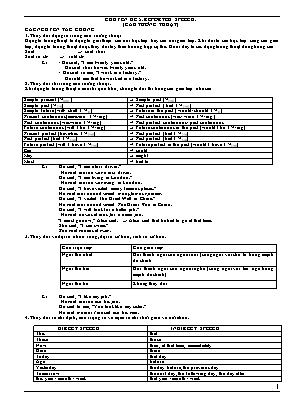

Luyện thi THPT Quốc gia môn Tiếng Anh Lớp 12 - Chuyên đề 5 Reported speech
Báo tài liệu không phù hợp
Xem trước nội dung
1
CHUYÊN ĐỀ 5: REPORTED SPEECH.
(CÂU TƯỜNG THUẬT) CÁC NGUYÊN TẮC CHUNG 1. Thay đổi động từ trong câu tường thuật Động từ tường thuật là động từ giới thiệu câu nói trực tiếp hay câu nói gián tiếp. Khi đổi từ câu trực tiếp sang câu gián tiếp, động từ tường thuật được thay đổi tùy theo trường hợp cụ thể. Dưới đây là các động tường thuật dùng trong câu: Said → said that Said to sb → told sb Ex: - He said, “I am twenty years old.”
He said that he was twenty years old. - He said to me, “I work in a factory.” He told me that he worked in a factory. 2. Thay đổi thì trong câu tường thuật: Khi động từ tường thuật ở các thì quá khứ, chúng ta đổi thì trong câu gián tiếp như sau:
Simple present (V(s/es)) Simple past (V2/ed ) Simple past (V2/ed) Past perfect ( had + V3/ed ) Simple future (will/ shall + V0 ) Future in the past ( would/ should + V0 ) Present continuous (am/is/are + V-ing) Past continuous (was/ were + V-ing ) Past continuous (was/were + V-ing) Past perfect continuous / past continuous Future continuous (will + be + V-ing) Future continuous in the past (would + be + V-ing) Present perfect (have/has + V3/ed) Past perfect (had + V3/ed) Past perfect (had + V3/ed) Past perfect (had + V3/ed) Future perfect (will + have + V3/ed) Future perfect in the past (would + have + V3/ed) Can could May might Must had to Ex: He said, “I am a taxi driver.” He said that he was a taxi driver. He said, “I am living in London.” He said that he was living in London. He said, “I have visited many famous places.” He said that he had visited many famous places. He said, “I visited The Great Wall in China.” He said that he had visited The Great Wall in China. He said, “I will look for a better job.” He said he would look for a better job. “I must go now,” Alice said. → Alice said that he had to go at that time.
She said, “I can swim.” She said she could swim. 3. Thay đổi về đại từ nhân xưng, đại từ sở hữu, tính từ sở hữu:
Câu trực tiếp Câu gián tiếp Ngôi thứ nhất Đôỉ thành ngôi của người nói (cùng ngôi với chủ từ trong mệnh đề chính
Ngôi thứ hai Đổi thành ngôi của người nghe (cùng ngôi với tân ngữ trong mệnh đề chính)
Ngôi thứ ba Không thay đổi
Ex: He said, “I like my job.” He said that he like his job. He said to me, “You look like my sister.” He told me that I looked like his siter. 4. Thay đổi từ chỉ định, các trạng từ và cụm từ chỉ thời gian và nơi chốn:
DIRECT SPEECH INDIRECT SPEECH This that These those Now then, at that time, immediately Here there Today that day Ago before Yesterday the day before, the previous day Tomorrow the next day, the following day, the day after this year / month / week that year / month / week
DeThi.edu.vn
2
* S + said + (that) + S + V * S + told + O + (that) + S + V
last year / month / week the year / month / week before; the previous year / month / week. next year / month / week the year / month / week after; the following year / month / week. a year / month / week ago a year / month / week before; a year / month / week earlier The day before yesterday Two days before The day after tomorrow Two days after
Ex: He said, “I am working hard today.” He said that he was working hard that day. They said, “We went to work late yesterday.” They said that they had gone to work late the day before.
* LƯU Ý: Các trường hợp KHÔNG thay đổi thì trong câu tường thuật: a. Câu điều kiện loại 2 và 3 Nếu câu nói trực tiếp là câu điều kiện loại 2 và loại 3, ta chỉ thay đổi các đại từ, tình từ…mà không đổi thì trong câu.
Ex: “If I were older, I would retire.”, he said. He said if he were older, he would retire. “If I had heard the whole story, I would have acted differently”, he said He said that if he had heard the whole story, he would have acted differently. b. Câu trực tiếp diễn tả một chân lí, hay một thói quen ở hiện tại. Nếu câu nói trực tiếp nói về một sự thật, một chân lí hay một thói quen thường xuyên lặp đi, lập lại ở hiện tại, khi đổi sang câu gián tiếp ta phải giữ nguyên thì của câu trực …
Trên đây là phần đầu tài liệu — bấm Đọc sách để xem đầy đủ.

.jpg "Bộ đề thi thử môn Tiếng Anh THPT 2026 mới nhất (Có lời giải)")




 file word Co Dap An.jpg "Đề thi thử Tốt nghiệp THPT 2026 Tiếng Anh Bắc Giang (Form Mới) file word Có Đáp Án")

.jpg "Đề Thi Thử Tốt Nghiệp THPT 2026 Tiếng Anh THPT Yên Dũng 2, Bắc Ninh (Có Đáp Án)")
