


Xem trước nội dung
ĐỀ THAM KHẢO LUYỆN THI TNPT 2020 - 04
Thời gian: 60 phút
Mã Đề 383
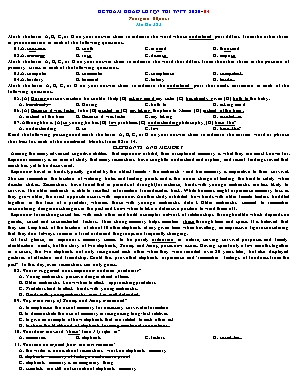
Mark the letter A, B, C, or D on your answer sheet to indicate the word whose underlined part differs from the other three in pronunciation in each of the following questions. 01.A. souvenir B. south C. around D. thousand 02.A. increase B. rose C. disease D. impose Mark the letter A, B, C, or D on your answer sheet to indicate the word that differs from the other three in the position of primary stress in each of the following questions. 03.A. computer B. commuter C. compliance D. competent 04.A. territory B. terminal C. tertiary D. terrific Mark the letter A, B, C, or D on your answer sheet to indicate the underlined part that needs correction in each of the following questions.
05. (A) During our conversation he couldn’t help (B) asking me if my sister (C) has already given (D) birth to the baby.
A. has already B. During C. birth to D. asking me if 06. (A) Because it was faster, John (B) insisted in (C) my taking the plane to Miami (D) instead of the train.
A. instead of the train B. Because it was faster C. my taking D. insisted in 07. Although he is (A) so young, he has (B) few problems (C) understanding philosophy, (D) hasn’t he?
A. understanding B. so C. few D. hasn’t he? Read the following passage and mark the letter A, B, C, or D on your answer sheet to indicate the correct word or phrase that best fits each of the numbered blanks from 08 to 14.
ELEPHANTS AND MEMORY Among the many advanced cognitive abilities that elephants exhibit, their exceptional memory is what they are most known for. Elephant memory is an area of study that many researchers have sought to understand and explain, and recent findings reveal that much has yet to be discovered. Elephants travel in herds typically guided by the oldest female - the matriarch - and her memory is imperative to their survival. She can remember the location of watering holes and feeding points and is the one in charge of leading the herd to safety when disaster strikes. Researchers have found that in periods of drought, for instance, herds with younger matriarchs are less likely to survive. The older matriarch is able to recollect information from decades back. While humans might experience memory loss as they grow older, the exact opposite occurs with elephants. Another study exhibited how herds with older female leaders huddled together in the face of a predator, whereas those with younger matriarchs didn’t. Older matriarchs seemed to remember encountering dangerous strangers in the past and knew when to take a defensive position to ward them off. Elephants form strong social ties with each other and build a complex network of relationships throughout life which depends on genetic, social and circumstantial factors. Their strong memory helps maintain these through time and space. It is believed that they can keep track of the location of about 30 other elephants at any given time when travelling; an impressive figure considering that they don’t always roam in a fixed order and the groups are frequently changing. At first glance, an elephant’s memory seems to be purely utilitarian in nature, serving survival purposes and family identification needs, but the story of two elephants, Shirley and Jenny, poses new issues. Having spent only a few months together in a circus, the two elephants not only recognised each other when they were reunited over 20 years later, but also displayed gestures of affection and friendship. Could this prove that elephants experience and ‘remember’ feelings of fondness from the past? To this day, even researchers can only guess.
08. What is suggested about elephants and their predators?
A. Young matriarchs perceive danger ahead of time. B. Older matriarchs know when to attack approaching predators C. Predators tend to attack herds with young matriarchs. D. Herds with young matriarchs aren’t as well defended. 09. Why is the story of Shirley and Jenny mentioned?
A. to …
Trên đây là phần đầu tài liệu — bấm Đọc sách để xem đầy đủ.

.jpg "Bộ đề thi thử môn Tiếng Anh THPT 2026 mới nhất (Có lời giải)")




 file word Co Dap An.jpg "Đề thi thử Tốt nghiệp THPT 2026 Tiếng Anh Bắc Giang (Form Mới) file word Có Đáp Án")

.jpg "Đề Thi Thử Tốt Nghiệp THPT 2026 Tiếng Anh THPT Yên Dũng 2, Bắc Ninh (Có Đáp Án)")
