

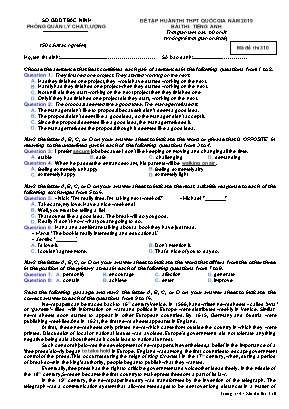

Đề tập huấn thi THPT Quốc gia môn Tiếng Anh Lớp 12 năm 2019 - Mã đề 310 - Sở giáo dục và đào tạo Bắc Ninh
Báo tài liệu không phù hợp
Xem trước nội dung
Trang 1/4 - Mã đề thi 310
SỞ GDĐT BẮC NINH PHÒNG QUẢN LÝ CHẤT LƯỢNG
ĐỀ TẬP HUẤN THI THPT QUỐC GIA NĂM 2019
BÀI THI: TIẾNG ANH Thời gian làm bài: 60 phút (không kể thời gian phát đề) (50 câu trắc nghiệm) Mã đề thi 310
Họ, tên thí sinh:....................................................................... Số báo danh:..........................................
Choose the sentence that best combines each pair of sentences in the following questions from 1 to 2. Question 1: They finished one project. They started working on the next.
A. Had they finished one project, they would have started working on the next. B. Hardly had they finished one project when they started working on the next. C. Not until did they start working on the next project then they finished one D. Only if they had finished one project did they start, working on the next. Question 2: The proposal seemed like a good idea. The manager refused it.
A. The manager didn’t like to proposal because it didn't seem a good idea. B. The proposal didn’t seem like a good idea, so the manager didn’t accept it. C. Since the proposal seemed like a good idea, the manager refused it. D. The manager refused the proposal though it seemed like a good idea.
Mark the letter A, B, C, or D on your answer sheet to indicate the word or phrase that is OPPOSITE in meaning to the underlined part in each of the following questions from 3 to 4. Question 3: I prefer secure jobs because I don’t like keeping on moving and changing all the time.
A. stable B. safe C. challenging D. demanding Question 4: When he passes the entrance exam, his parents will be walking on air.
A. feeling extremely unhappy B. feeling extremely airy C. extremely happy D. extremely light
Mark the letter A, B, C, or D on your answer sheet to indicate the most suitable response to each of the following exchanges from 5 to 6. Question 5: - Nick: "I’m really tired. I’m taking next week off." - Michael: "_______"
A. Take care, my love. Have a nice weekend! B. Well, you must be telling a lie! C. That sounds like a good idea. The break will do you good. D. Really? I don’t know what you are going to do. Question 6: Hana and Jenifer are talking about a book they have just read.
- Hana: “The book is really interesting and educational.” - Jenifer: “_______” A. I’d love it. B. Don’t mention it. C. I couldn’t agree more. D. That’s nice of you to say so.
Mark the letter A, B, C, or D on your answer sheet to indicate the word that differs from the other three in the position of the primary stress in each of the following questions from 7 to 8. Question 7: A. personify B. encourage C. affection D. generate Question 8: A. contain B. achieve C. enter D. improve
Read the following passage and mark the letter A, B, C, or D on your answer sheet to indicate the correct answer to each of the questions from 9 to 16.
Newspapers can be traced back to 16th century Venice. In 1566, handwritten news sheets - called 'avis' or ‘gazette' - filled with information on wars and politics in Europe were distributed weekly in Venice. Similar news sheets soon started to appear in other European countries. By 1615, Germany and Austria were publishing weeklies. And in 1621, the first news sheets appeared in England.
At first, these news sheets only printed news which came from outside the country in which they were printed. Discussion of local or national issues was avoided. Europe’s governments did not tolerate anything negative being said about them as it could lead to national unrest.
Such censorship slowed the development of newspapers. Nevertheless, a belief in the importance of a 'free press’ slowly began to take hold in Europe. England was among the first countries to escape government control of the press. This occurred during the reign of King Charles I in the 17th century, when, during a period of breakdown in the king's authority, people began to publish what they wanted.
Eventually, free press had the right to criticize government …
Trên đây là phần đầu tài liệu — bấm Đọc sách để xem đầy đủ.

.jpg "Bộ đề thi thử môn Tiếng Anh THPT 2026 mới nhất (Có lời giải)")




 file word Co Dap An.jpg "Đề thi thử Tốt nghiệp THPT 2026 Tiếng Anh Bắc Giang (Form Mới) file word Có Đáp Án")

.jpg "Đề Thi Thử Tốt Nghiệp THPT 2026 Tiếng Anh THPT Yên Dũng 2, Bắc Ninh (Có Đáp Án)")
