

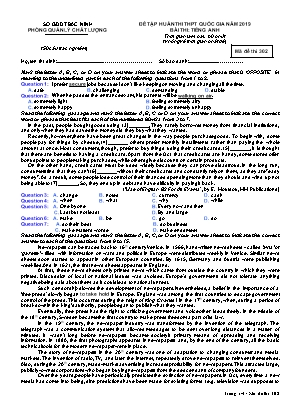

Đề tập huấn thi THPT Quốc gia môn Tiếng Anh Lớp 12 năm 2019 - Mã đề 302 - Sở giáo dục và đào tạo Bắc Ninh
Báo tài liệu không phù hợp
Xem trước nội dung
Trang 1/4 - Mã đề thi 302
SỞ GDĐT BẮC NINH PHÒNG QUẢN LÝ CHẤT LƯỢNG
ĐỀ TẬP HUẤN THI THPT QUỐC GIA NĂM 2019
BÀI THI: TIẾNG ANH Thời gian làm bài: 60 phút (không kể thời gian phát đề) (50 câu trắc nghiệm) Mã đề thi 302
Họ, tên thí sinh:....................................................................... Số báo danh:..........................................
Mark the letter A, B, C, or D on your answer sheet to indicate the word or phrase that is OPPOSITE in meaning to the underlined part in each of the following questions from 1 to 2. Question 1: I prefer secure jobs because I don’t like keeping on moving and changing all the time.
A. safe B. challenging C. demanding D. stable Question 2: When he passes the entrance exam, his parents will be walking on air.
A. extremely light B. feeling extremely airy C. extremely happy D. feeling extremely unhappy Read the following passage and mark the letter A, B, C or D on your answer sheet to indicate the correct word or phrase that best fits each of the numbered blanks from 3 to 7.
In the past, people bought goods using (3)_______. They rarely borrowed money from financial institutions, and only when they had saved the money did they buy what they wanted.
Recently, however, there have been great changes in the way people purchase goods. To begin with, some people pay for things by cheque, (4)_______ others prefer monthly installments rather than paying the whole amount at once. Most consumers, though, prefer to buy things using their credit cards. (5)_______, it is thought that there are benefits to having a credit card. Apart from the fact that credit cards are handy, some stores offer bonus points to people making purchases, while others give discounts on certain products.
On the other hand, credit cards must be used wisely because they can prove disastrous. In the long run, consumers find that they can't (6)_______ without their credit cards and constantly rely on them, as they are "easy money". As a result, some people lose control of their finances spending more than they should and wind up not being able to (7)_______. So, they end up in debt and have difficulty in paying it back.
("Use of English B2 For All Exams”, by E. Moutsou, MM Publications) Question 3: A. change B. notes C. currency D. cash Question 4: A. when B. what C. why D. while Question 5: A. One by one B. Every now and then C. Last but not least D. By and large Question 6: A. make B. be C. go D. do Question 7: A. do their best B. do business C. make matters worse D. make ends meet Read the following passage and mark the letter A, B, C, or D on your answer sheet to indicate the correct answer to each of the questions from 8 to 15.
Newspapers can be traced back to 16th century Venice. In 1566, handwritten news sheets - called 'avis' or ‘gazette' - filled with information on wars and politics in Europe were distributed weekly in Venice. Similar news sheets soon started to appear in other European countries. By 1615, Germany and Austria were publishing weeklies. And in 1621, the first news sheets appeared in England.
At first, these news sheets only printed news which came from outside the country in which they were printed. Discussion of local or national issues was avoided. Europe’s governments did not tolerate anything negative being said about them as it could lead to national unrest.
Such censorship slowed the development of newspapers. Nevertheless, a belief in the importance of a 'free press’ slowly began to take hold in Europe. England was among the first countries to escape government control of the press. This occurred during the reign of King Charles I in the 17th century, when, during a period of breakdown in the king's authority, people began to publish what they wanted.
Eventually, free press had the right to criticize government and voice other ideas freely. In the middle of the 18th century, Sweden became the first country to make press freedom a part of its law.
In the 19th century, the …
Trên đây là phần đầu tài liệu — bấm Đọc sách để xem đầy đủ.

.jpg "Bộ đề thi thử môn Tiếng Anh THPT 2026 mới nhất (Có lời giải)")




 file word Co Dap An.jpg "Đề thi thử Tốt nghiệp THPT 2026 Tiếng Anh Bắc Giang (Form Mới) file word Có Đáp Án")

.jpg "Đề Thi Thử Tốt Nghiệp THPT 2026 Tiếng Anh THPT Yên Dũng 2, Bắc Ninh (Có Đáp Án)")
