


Đề thi thử THPT Quốc gia môn Tiếng Anh lần I năm 2020 - Mã đề 401 - Trường THPT chuyên Phan Ngọc Hiển
Báo tài liệu không phù hợp
Xem trước nội dung
Trang 1/5 - Mã đề 401
SỞ GIÁO DỤC VÀ ĐÀO TẠO CÀ MAU TRƯỜNG THPT CHUYÊN PHAN NGỌC HIỂN
ĐỀ THI THỬ THPT QUỐC GIA - LẦN I NĂM 2020
MÔN TIẾNG ANH Thời gian làm bài: 60 Phút; (Đề có 50 câu)
(Đề có 5 trang)
Họ tên: ............................................................... Số báo danh: ...................
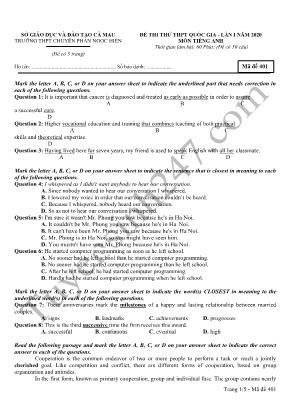
Mark the letter A, B, C, or D on your answer sheet to indicate the underlined part that needs correction in each of the following questions. Question 1: It is important that cancer is diagnosed and treated as early as possible in order to assure A B C a successful cure. D Question 2: Higher vocational education and training that combines teaching of both practical A B C skills and theoretical expertise. D Question 3: Having lived here for seven years, my friend is used to speak English with all her classmate. A B C D Mark the letter A, B, C, or D on your answer sheet to indicate the sentence that is closest in meaning to each of the following questions. Question 4: I whispered as I didn't want anybody to hear our conversation. A. Since nobody wanted to hear our conversation I whispered. B. I lowered my voice in order that our conversation couldn’t be heard. C. Because I whispered, nobody heard our conversation. D. So as not to hear our conversation I whispered. Question 5: I'm sure it wasn't Mr. Phong you saw because he's in Ha Noi. A. It couldn't be Mr. Phong you saw because he's in Ha Noi. B. It can't have been Mr. Phong you saw because he's in Ha Noi. C. Mr. Phong is in Ha Noi, so you might have seen him. D. You mustn't have seen Mr. Phong because he's in Ha Noi. Question 6: He started computer programming as soon as he left school. A. No sooner had he left school than he started computer programming. B. No sooner had he started computer programming than he left school. C. After he left school, he had started computer programming. D. Hardly had he started computer programming when he left school. Mark the letter A, B, C, or D on your answer sheet to indicate the word(s) CLOSEST in meaning to the underlined word(s) in each of the following questions. Question 7: These anniversaries mark the milestones of a happy and lasting relationship between married couples. A. signs B. landmarks C. achievements D. progresses Question 8: This is the third successive time the firm receives this award. A. successful B. continuous C. eventual D. high Read the following passage and mark the letter A, B, C, or D on your answer sheet to indicate the correct answer to each of the questions.
Cooperation is the common endeavor of two or more people to perform a task or reach a jointly cherished goal. Like competition and conflict, there are different forms of cooperation, based on group organization and attitudes.
In the first form, known as primary cooperation, group and individual fuse. The group contains nearly
Mã đề 401
DeThi.edu.vn
Trang 2/5 - Mã đề 401
all of each individual’s life. The rewards of the group’s work are shared with each member. There is an interlocking identity of individual, group and task performed. Means and goals become one, for cooperation itself is valued.
While primary cooperation is most often characteristic of preliterature societies, secondary cooperation is characteristic of many modem societies. In secondary cooperation, individuals devote only part of their lives to the group. Cooperation itself is not a value. Most members of the group feel loyalty, but the welfare of the group is not the first consideration. Members perform tasks so that they can separately enjoy the fruits of their cooperation in the form of salary, prestige, or power. Business offices and professional athletic teams are examples of secondary cooperation.
In the third type, called tertiary cooperation or accommodation, latent conflict underlies the shared work. The attitudes of the cooperating parties are purely opportunistic: the organization is loose and fragile. Accommodation involves common means to achieve antagonistic …
Trên đây là phần đầu tài liệu — bấm Đọc sách để xem đầy đủ.

.jpg "Bộ đề thi thử môn Tiếng Anh THPT 2026 mới nhất (Có lời giải)")




 file word Co Dap An.jpg "Đề thi thử Tốt nghiệp THPT 2026 Tiếng Anh Bắc Giang (Form Mới) file word Có Đáp Án")

.jpg "Đề Thi Thử Tốt Nghiệp THPT 2026 Tiếng Anh THPT Yên Dũng 2, Bắc Ninh (Có Đáp Án)")
