

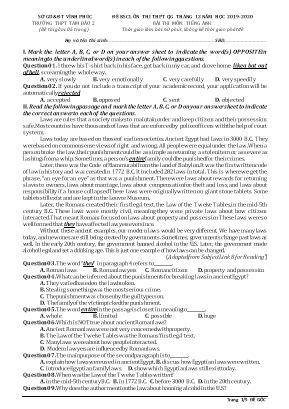

Đề thi Khảo sát chất lượng ôn thi THPT Quốc gia Tháng 12 môn Tiếng Anh Lớp 12 - Năm học 2019-2020 - Trường THPT Tam Đảo 2
Báo tài liệu không phù hợp
Xem trước nội dung
Trang 1/5 ĐỀ GỐC
SỞ GD&ĐT VĨNH PHÚC TRƯỜNG THPT TAM ĐẢO 2
(Đề thi gồm: 05 trang)
ĐỀ KSCL ÔN THI THPT QG THÁNG 12 NĂM HỌC 2019-2020
BÀI THI MÔN: TIẾNG ANH Thời gian làm bài: 60 phút, không kể thời gian phát đề
Họ và tên thí sinh:……………………………………………………………………. SBD:…………………………
I. Mark the letter A, B, C, or D on your answer sheet to indicate the word(s) OPPOSITE in meaning to the underlined word(s) in each of the following questions. Question 01. I threw his T-shirt back in his face, got back in my car, and drove home like a bat out of hell, screaming the whole way.
A. very slowly B. very emotionally C. very carefully D. very speedily Question 02. If you do not include a transcript of your academic record, your application will be automatically rejected.
A. accepted B. opposed C. sent D. objected II. Read the following passage and mark the letter A, B, C, or D on your answer sheet to indicate the correct answer to each of the questions.
Laws are rules that a society makes to maintain order and keep citizens and their possessions safe. Most countries have thousands of laws that are enforced by police officers with the help of court systems.
Laws today are based on those of earlier societies. Ancient Egypt had laws in 3000 B.C. They were based on common sense views of right and wrong. All people were equal under the law. When a person broke the law, their punishment could be as simple as returning a stolen item or as severe as lashings from a whip. Sometimes, a person’s entire family could be punished for their crimes.
Later, there was the Code of Hammurabi from the land of Babylon. It was the first written code of law in history and was created in 1772 B.C. It included 282 laws in total. This is where we get the phrase, “an eye for an eye” as that was a punishment. There were laws about rewards for returning slaves to owners, laws about marriage, laws about compensation for theft and loss, and laws about responsibility if a house collapsed. These laws were originally written on giant stone tablets. Some tablets still exist and are kept in the Louvre Museum.
Later, the Romans created their first legal text, the Law of the Twelve Tables, in the mid-5th century B.C. These laws were mostly civil, meaning they were private laws about how citizens interacted. That meant Romans focused on laws about property and possession. These laws were so well formed that they have affected lawyers ever since.
Without these ancient examples, our modern laws would be very different. We have many laws today, and new ones are still being created by governments. Sometimes, governments change past laws as well. In the early 20th century, the government banned alcohol in the U.S. Later, the government made alcohol legal and set a drinking age. This is just one example of how laws can be changed.
(Adapted from Subject Link 8 for Reading'') Question 03. The word “they” in paragraph 4 refers to_________.
A. Roman laws B. Roman lawyers C. Roman citizens D. property and possession Question 04. What can be inferred about the punishments for breaking laws in ancient Egypt?
A. They varied based on the law broken. B. Stealing something was the most serious crime. C. The punishment was chosen by the guilty person. D. The family of the victim picked the punishment. Question 05. The word entire in the passage is closest in meaning to_________.
A. whole B. limited C. possible D. huge Question 06. Which is NOT true about ancient Roman laws?
A. Ancient Roman laws were not very concerned with property. B. The Law of the Twelve Tables was the Romans’ first legal text. C. Many laws were about how people interacted. D. Modern lawyers are influenced by Roman laws. Question 07. The main purpose of the second paragraph is to_________.
A. explain how laws were used in ancient Egypt. B. discuss how Egyptian laws were written. C. introduce Egyptian family laws. D. show which Egyptian laws still exist today. Question 08. When was the Law of the Twelve Tables …
Trên đây là phần đầu tài liệu — bấm Đọc sách để xem đầy đủ.

.jpg "Bộ đề thi thử môn Tiếng Anh THPT 2026 mới nhất (Có lời giải)")




 file word Co Dap An.jpg "Đề thi thử Tốt nghiệp THPT 2026 Tiếng Anh Bắc Giang (Form Mới) file word Có Đáp Án")

.jpg "Đề Thi Thử Tốt Nghiệp THPT 2026 Tiếng Anh THPT Yên Dũng 2, Bắc Ninh (Có Đáp Án)")
