


Đề thi thử tốt nghiệp THPT môn Tiếng Anh năm 2021 - Trường THPT Chuyên Chu Văn An, Bình Định (Có đáp án)
Báo tài liệu không phù hợp
Xem trước nội dung
1
SỞ GD - ĐT BÌNH ĐỊNH TRƯỜNG THPT CHUYÊN CHU VĂN AN
(Đề thi có 05 trang)
KỲ THI THỬ TỐT NGHIỆP THPT NĂM 2021
Bài thi: NGOẠI NGỮ, Môn thi: TIẾNG ANH Thời gian làm bài: 60 phút, không kể thời gian phát đề
Họ, tên thí sinh: ………………………, SBD: ……………………………. Read the following passage and mark the letter A, B, C, or D on your answer sheet to indicate the correct answer to each of the questions
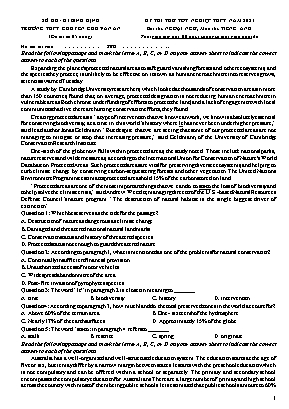
Expanding the planet's protected natural areas to safeguard vanishing forests and other ecosystems, and the species they protect, is unlikely to be effective on its own as human encroachment into reserves grows, scientists warned Tuesday.
A study by Cambridge University researchers, which looked at thousands of conservation areas in more than 150 countries, found that, on average, protected designation is not reducing human encroachment in vulnerable areas. Both chronic underfunding of efforts to protect the land, and a lack of engagement with local communities that live there are hurting conservation efforts, they found.
Creating protected areas is “a type of intervention that we know can work, we know is absolutely essential for conserving biodiversity, at a time in this world’s history where it has never been under higher pressure,” said lead author Jonas Geldmann. “But despite that we are seeing that some of our protected areas are not managing to mitigate or stop that increasing pressure,” said Geldmann, of the University of Cambridge Conservation Research Institute.
One-sixth of the globe now falls within protected areas, the study noted. Those include national parks, nature reserves and wilderness areas, according to the International Union for Conservation of Nature's World Database on Protected Areas. Such protected areas are vital for preserving diverse ecosystems, and helping to curb climate change by conserving carbon-sequestering forests and other vegetation. The United Nations Environment Programme estimates protected areas hold 15% of the carbon stored on land.
“Protected areas are one of the most important things that we can do to stem the loss of biodiversity and to help solve the climate crisis,” said Andrew Wetzler, managing director of the U.S.-based Natural Resources Defense Council’s nature program. “The destruction of natural habitat is the single biggest driver of extinction.” Question 1: Which best serves as the title for the passage? A. Destruction of nature as dangerous as climate change B. Damaged and threatened national natural landmarks C. Conservation status and history of threatened species D. Protected status not enough to guard threatened nature Question 2: According to paragraph 1, what is mentioned as one of the problems for natural conservation? A. Continually insufficient financial provision B. Unauthorized access of motor vehicles C. Widespread abandonment of the area D. Post- fire invasion of pyrophytes species Question 3: The word “it” in paragraph 2 is closet in meaning to _______ A. time B. biodiversity C. history D. intervention Question 4: According to paragraph 3, how much land do the total preserved zones in the world account for? A. Above 60% of the terrain area B. One- sixteenth of the hydrosphere C. Nearly 17% of the earth surfaces D. Approximately 15% of the globe Question 5: The word “stem: in paragraph 4 refers to _______ A. stalk B. restrict C. spring D. originate Read the following passage and mark the letter A, B, C, or D on your answer sheet to indicate the correct answer to each of the questions
Australia has a well-organized and well-structured education system. The education starts at the age of five or six, but it may differ by a narrow margin between states. It starts with the preschool education which is not compulsory and can be offered within a school or separately. The primary and secondary school encompasses the compulsory education for Australians. There are a large number of primary and high school across the country with most of them being public schools. It is …
Trên đây là phần đầu tài liệu — bấm Đọc sách để xem đầy đủ.

.jpg "Bộ đề thi thử môn Tiếng Anh THPT 2026 mới nhất (Có lời giải)")




 file word Co Dap An.jpg "Đề thi thử Tốt nghiệp THPT 2026 Tiếng Anh Bắc Giang (Form Mới) file word Có Đáp Án")

.jpg "Đề Thi Thử Tốt Nghiệp THPT 2026 Tiếng Anh THPT Yên Dũng 2, Bắc Ninh (Có Đáp Án)")
