

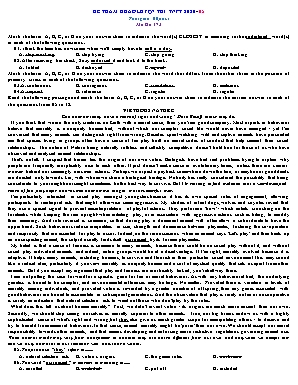

4 Đề tham khảo thi Trung học Phổ thông Quốc gia môn Tiếng Anh năm 2020
Báo tài liệu không phù hợp
Xem trước nội dung
ĐỀ THAM KHẢO LUYỆN THI TNPT 2020 - 05
Thời gian: 60 phút
Mã Đề 173
Mark the letter A, B, C, or D on your answer sheet to indicate the word(s) CLOSEST in meaning tothe underlined word(s) in each of the following questions.
01. 1think the time has now come when we'll simply have to call it a day.
A. stop working B. stop trying C. stop going D. stop thinking 02. After receiving her check, Suzy endorsed it and took it to the bank.
A. folded B. destroyed C. signed D. deposited Mark the letter A, B, C, or D on your answer sheet to indicate the word that differs from the other three in the position of primary stress in each of the following questions. 03.A. continuous B. courageous C. scandalous D. malicious 04.A. request B. reference C. register D. regular Read the following passage and mark the letter A, B, C, or D on your answer sheet to indicate the correct answer to each of the questions from 05 to 12.
VIRTUOUS NATURE Can animals really have a sense of right and wrong? Marc Bekoff thinks they do. If you think that we are the only creatures on Earth with a moral sense, then you're in good company. Most experts in behaviour believe that morality is a uniquely human trait, without which our complex social life would never have emerged - yet I'm convinced that many animals can distinguish right from wrong. Decades spent watching wild and captive animals have persuaded me that species living in groups often have a sense of fair play built on moral codes of conduct that help cement their social relationships. The notion of Nature being naturally ruthless and selfishly competitive doesn't hold true for those of us who have observed and analysed animal relationships. That's not all. I suspect that herein lies the origin of our own virtue. Biologists have had real problems trying to explain why people are frequently inexplicably nice to each other. It just doesn't make sense in evolutionary terms, unless there are ulterior motives behind our seemingly altruistic actions. Perhaps we expect a payback somewhere down the line, or maybe our good deeds are directed only towards kin, with whom we share a biological heritage. Nobody has really considered the possibility that being considerate to your neighbours might sometimes be the best way to survive. But I'm starting to find evidence that a well-developed sense of fair play helps non-human animals live longer, more successful lives. I'm particularly interested in social play amongst youngsters because it has its own special rules of engagement, allowing participants to reinterpret acts that might otherwise seem aggressive. My studies of infant dogs, wolves and coyotes reveal that they use a special signal to prevent misinterpretation of playful actions. They perform a 'bow' - which entails crouching on the forelimbs while keeping the rear upright-when initiating play, or in association with aggressive actions such as biting, to modify their meaning. And role reversal is common, so that during play a dominant animal will often allow a subordinate to have the upper hand. Such behaviours reduce inequalities in size, strength and dominance between playmates, fostering the co-operation and reciprocity that are essential for play to occur. Indeed, on the rare occasions when an animal says 'Let's play' and then beats up an unsuspecting animal, the culprit usually finds itself ostracized by its former playmates. My belief is that a sense of fairness is common to many animals, because there could be no social play without it, and without social play individual animals and indeed, entire groups would be at a disadvantage. If I'm right, morality evolved because it is adaptive. It helps many animals, including humans, to survive and flourish in their particular social environment This may sound like a radical idea, particularly if you view morality as uniquely human and a sort of mystical quality that sets us apart from other animals. But if you accept my argument that play and fairness are …
Trên đây là phần đầu tài liệu — bấm Đọc sách để xem đầy đủ.

.jpg "Bộ đề thi thử môn Tiếng Anh THPT 2026 mới nhất (Có lời giải)")




 file word Co Dap An.jpg "Đề thi thử Tốt nghiệp THPT 2026 Tiếng Anh Bắc Giang (Form Mới) file word Có Đáp Án")

.jpg "Đề Thi Thử Tốt Nghiệp THPT 2026 Tiếng Anh THPT Yên Dũng 2, Bắc Ninh (Có Đáp Án)")
