
Xem trước nội dung
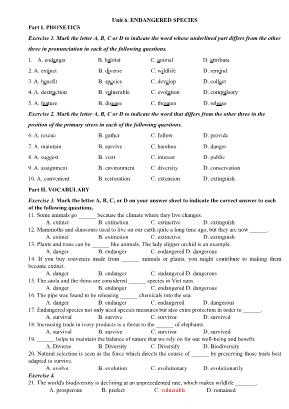
Unit 6. ENDANGERED SPECIES Part I. PHONETICS
Exercise 1. Mark the letter A, B, C or D to indicate the word whose underlined part differs from the other
three in pronunciation in each of the following questions.
1. A. endanger B. habitat C. animal D. attribute
2. A. extinct B. diverse C. wildlife D. remind
3. A. benefit B. species C. develop D. collect
4. A. destruction B. vulnerable C. evolution D. compulsory
5. A. feature B. disease C. threaten D. release
Exercise 2. Mark the letter A, B, C or D to indicate the word that differs from the other three in the
position of the primary stress in each of the following questions.
6. A. rescue B. gather C. follow D. provide
7. A. maintain B. survive C. bamboo D. danger
8. A. suggest B. visit C. interest D. public
9. A. assignment B. environment C. diversity D. conservation
10. A. convenient B. restoration C. extension D. extinguish
Part II. VOCABULARY
Exercise 3. Mark the letter A, B, C, or D on your answer sheet to indicate the correct answer to each of the following questions. 11. Some animals go ______ because the climate where they live changes. A. extinct B. extinction C. extinctive D. extinguish 12. Mammoths and dinosours used to live on our earth quite a long time ago, but they are now ______. A. extinct B. extinction C. extinctive D. extinguish 13. Plants and trees can be ______ like animals. The lady slipper orchid is an example. A. danger B. endanger C. endangered D. dangerous 14. If you buy souvenirs made from ______ animals or plants, you might contribute to making them become extinct. A. danger B. endanger C. endangered D. dangerous 15. The saola and the rhino are considered ______ species in Viet nam. A. danger B. endanger C. endangered D. dangerous 16. The pipe was found to be releasing ______ chemicals into the sea. A. danger B. endanger C. endangered D. dangerous 17. Endangered species not only need species measures but also extra protection in order to ______. A. survival B. survive C. survivor D. survived 18. Increasing trade in ivory products is a threat to the ______ of elephants. A. survival B. survive C. survivor D. survived 19. ______ helps to maintain the balance of nature that we rely on for our well-being and benefit. A. Diverse B. Diversity C. Diversify D. Biodiversity 20. Natural selection is seen as the force which directs the course of ______ by preserving those traits best adapted to survive. A. evolve B. evolution C. evolutionary D. evolutionarily Exercise 4. 21. The world's biodiversity is declining at an unprecedented rate, which makes wildlife _______.
A. prosperous B. prefect C. vulnerable D. remained
DeThi.edu.vn
22. Toxic chemicals from factories are one of the serious factors that leads wildlife to the _______ of extinction. A. wall B. fence C. verge D. bridge 23. If an area is _______, all the trees there are cut down or destroyed.
A. endangered B. deforested C. contaminated D. polluted 24. Dinosaurs have been ______ for millions of years. A. endangered B. extinct C. threatened D. disappear 25. The tiger is ______ of extinction. It is difficult to find them in the wild. A. on the wing B. on the moon C. on the verge D. on the ground 26. The climate may become wetter or drier. It may become warmer or cooler. If the animals cannot change or ______ to the new climate, they will die. A. adapt B. adopt C. evolve D. resolve 27. Sometimes many of the animals on earth go extinct at the same time. Scientists call this a ______ extinction. A. huge B. great C. mass D. giant 28. Some animals go extinct because they cannot ______ with other animals for food. A. complete B. fight C. compete D. exist 29. Because of people’s ______ with the environment, many kinds of plants and animals are becoming rare. A. supply B. survival C. influence D. interference 30. I think the best way to ______ wild animals and plants is to protect their habitat. A. evolve B. concern C. conserve D. grow Exercise 1. Many species of animals and plants today are …
Trên đây là phần đầu tài liệu — bấm Đọc sách để xem đầy đủ.