.jpg)

Đề ôn thi học sinh giỏi môn Tiếng Anh Lớp 7 - Lệ Đình Quyên (Kèm đáp án)
Báo tài liệu không phù hợp
Xem trước nội dung
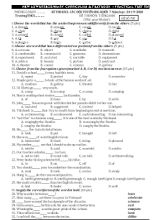
Fullname : LE DINH QUYEN PRACTICE TEST 1
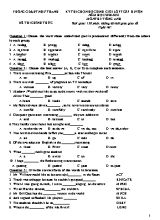
I. Choose the best answer A, B, C or D to complete the following sentences 1. Our teacher came in when we __________noisily.
A. talked B. were talking C. have been talking D. are talking 2. ________I were you, I would take a taxi to the airport.
A. If B. Unless C. Because D. When 3. Would you like to have _______coffee?
A. little B. many C. some D. any 4. ________ milk is an important source of ___________ protein and calcium.
A. The/ the B. _/ _ C. The/ - D. _/ the 5. Miss White sang very _______at my birthday party last night.
A. beauty B. beautiful C. beautifully D. beautify 6. She hasn’t written to John ________she left school.
A. when B. after C. since D. for 7. You have got a scholarship. You are ___________than I am.
A. more lucky B. lucky C. the luckiest D. luckier 8. Don’t read that book. It is _________.
A. interesting B. interested C. boring D. bored 9. French ____________in Quebec, Canada.
A. speaks B. is spoken C. speak D. is speaking 10. We didn’t enjoy our holidays ________the weather was so bad.
A. if B. because C. although D. but 11. Isaac Newton died in 1727 ________the age of eighty-five.
A. at B. on C. in D. with 12. This school is only for children _________ first language is not English.
A. who B. which C. that D. whose 13. Yesterday I ______finish the work because I was very tired.
A. could B. couldn’t C. can’t D. mustn’t 14. My friend asked me who _________the piano in the sitting room.
A. is playing B. was playing C. plays D. has played 15. I can wait. Four weeks ______not so long.
A. is B. are C. be D. to be
II. Read the following passages and then choose the best answer A, B, C or D to each question
Passage 1:
By adopting a few simple techniques, parents who read to their children can substantially increase their children’s language development. It’s surprising but true.
DeThi.edu.vn
How parents talk to their children makes a big difference in the children’s language development. If a parent encourages the child to actively respond to what the parent is reading, the child’s language skills increase.
A study was done with two- to three- year-old children and their parents. Half of the thirty children participated in the experimental study, the other half acted as the control group. In the experimental group, the parents were given a two-hour training session in which they were taught to ask open-ended questions rather than yes/no questions. For example, the parents should ask, “What is the doggie doing? “ rather than “Is the doggie running away?”. Experimental parents were also instructed in how to expand on their children’s answers, how to suggest alternative possibilities, and how to praise correct answers.
At the beginning of the study, the children did not differ on measures of language development, but at the end of one month, the children in the experimental group tested 5.5 months ahead of the control group on a test of verbal expression and vocabulary. Nine months later, the children in the experimental group still showed an advance of 6 months over the children in the control group.
1. Which of the following can be inferred from the passage?
A. Children who talk a lot are more intelligent. B. Parents who listen to their children can teach them more. C. Active children should read more. D. Verbal ability can easily be increased. 2. What does the word “It ” refer to?
A. Parents increasing children’s language development. B. Reading techniques being simple C. Parents reading to children. D. Children’s language development. 3. According to the author, which of the following questions is the best type to ask children about reading?
A. Do you see the elephant? B. Is the elephant in the cage? C. What animals do you like? D. Shall we go to the zoo? 4. What was the difference between the control group and the experimental group?
A. The training parents received. B. The age of the children. C. The books that were read. D. The number …
Trên đây là phần đầu tài liệu — bấm Đọc sách để xem đầy đủ.
.jpg "Đề thi HSG Tiếng Anh 7 cấp huyệnthành phố Uông Bí 2023-2024 có đáp án và file nghe (word+pdf)")