(Co dap an).jpg)

Đề kiểm tra học kì II môn Tiếng Anh Khối 7 (Thí điểm) (Có đáp án)
Báo tài liệu không phù hợp
Xem trước nội dung
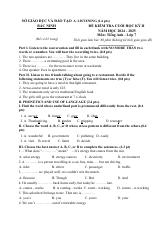
Full name: ...............................................
Class: ......................................................
ENGLISH LANGUAGE TEST
Time: 45 minutes
I. LISTENING
1. Listen to Minh predicting the future. Decide if the statements are true (T) or false (F). Circle T or F. You will listen TWICE.
1. There will be flying cars and robots. T F 2. Everything will be green. T F 3. We will use more energy from the sun. T F 4. We will not like touch screen. T F 5. A serious sickness will be cured. T F 2. Listen to the following interview with Lana Russel, a social worker in India. Fill each of the gaps in the notes with NO MORE THAN THREE words and/or a number. You will listen TWICE.
THE WORLD’S SLUMS - Slums = overcrowded sections of a city where people live in or near (1) _____________ - 2012: 33% of (2) _____________ live in slums - Biggest slum in the world: Neza-Chalco-Itza in (3) _____________: 4 million people - Biggest slum in Asia: Dharavi in India: (4) _____________ people - A major cause of slums: (5) _____________ immigration.
II. READING
1. Read the passage and answer the questions. Circle A, B, or C.
How can we solve the problem of traffic congestions in big cities? Governments have built highways, offered public transportation, etc. However, these traditional approaches are becoming expensive. Many experts now see intelligent transportation systems (ITS) as the solution. But how does ITS work? Using information technology (IT), intelligent vehicles and infrastructure broadcast and receive data from sensors, video cameras, radar, and satellites, etc. to improve traffic quality. Drivers receive messages on computers or mobile devices about accidents, travel times, alternative routes, and the like. These allow drivers to make better decisions. Managers of transportation infrastructure (roads, bridges, train stations, traffic signals, etc.) receive ITS data, then use it to control the system by changing traffic signal timing, broadcasting radio announcements, opening and closing roads and traffic lanes, responding to accidents and the like. Computers, rather than humans, make most of the decisions that control the system.
1. What does the passage mostly do? A. suggest a solution to a problem B. question a suggested solution C. explain how a solution works
2. What can the word “broadcast” be best replaced by? A. drive B. send C. direct
3. What does the word “These” in paragraph 2 refer to? A. messages B. devices C. routes
4. According to the passage, what happens to the data collected by sensors, cameras, satellites, etc.? A. It is stored in computers for later use. B. It is transmitted to drivers and traffic managers. C. It is used by engineers to change the system.
DeThi.edu.vn
5. Which of the following can be inferred from the passage? A. ITS will offer a cheaper solution to solving traffic problems. B. Machines will replace human beings in managing traffic system. C. Governments will switch to ITS instead of using traditional measures.
2. Read a passage about fossil fuels. Decide if the statements are true (T) or false (F). Circle T or F.
There are three major forms of fossil fuels: coal, oil and natural gas. All three were formed many hundreds of millions of years ago before the time of the dinosaurs – therefore we call them fossil fuels.
Fossil fuels take millions of years to make. But they are not unlimited. We are using up the fuels that were made more than 300 million years ago. They are not renewable like solar power, wind power, hydro power or biomass. Once they are gone they are gone. So, it’s best not to waste fossil fuels.
We can save fossil fuels by conserving energy. One simple way to do this is to turn off appliances, TVs and radios that we are not using. We can also turn off lights when no one is in the room. Another way is to go by bike or walk instead of driving cars or motorbikes.
1. Three major forms of fossil fuels are oil, coal and natural gas. T F 2. They were formed …
Trên đây là phần đầu tài liệu — bấm Đọc sách để xem đầy đủ.



.jpg "Bộ 25 Đề thi tiếng Anh Lớp 7 học kì 2 năm học 2024-2025 (Có đáp án)")