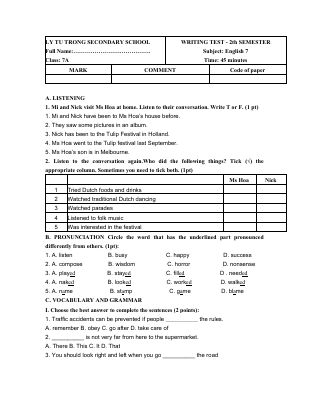
(Co dap an).jpg)

Đề kiểm tra học kì 2 môn Tiếng Anh Khối 7 (Thí điểm) (Có đáp án)
Báo tài liệu không phù hợp
Xem trước nội dung
Full name: ...............................................
Class: ......................................................
ENGLISH LANGUAGE TEST
Time: 45 minutes
I. LISTENING
1. Listen to Mai talking about the Mid-Autumn Festival in Viet Nam. Fill each of the gaps in the notes with NO MORE THAN THREE words. You will listen TWICE.
1. The Mid-Autumn Festival is celebrated in ______ in Viet Nam.
2. On this day, the moon is ______.
3. The moon cakes have various ______.
4. Moon cakes can be ______ or bought from bakers.
5. The lanterns are in all ______.
2. Listen to a talk between Tom and Lee about the Hungry Ghosts Festival. Decide if the statements are true (T) or false (F). Circle T or F. You will listen TWICE.
1. The Hungry Ghosts Festival is celebrated in China. T F 2. It’s the day when Chinese people have a holiday. T F 3. Some ghosts are friendly, some harm people. T F 4. People make food and invite ghosts in. T F 5. Tom feels it’s an interesting festival. T F II. READING
1. Read the passage and answer each question. Circle A, B, or C.
The Shichi-go-san Festival
Shichi-go-san is a Japanese festival. The Japanese celebrate it on 15 November every year. This is because people believe it is a day of good luck for all Japanese people.
Shichi-go-san means “seven-five-three” and the festival is for children who are seven, five and three. The Japanese think these ages are very important years. Japanese parents celebrate Shichi-go-san as their boys turn three and five and their girls turn three and seven.
At the age of seven, a girl wears obi - the piece of cloth worn round the waist over the kimono - for the first time. At the age of five, a boy wears his first hakama pants – the pants that Samurai wore in the past - in public. The age of three is important for the Japanese too.They think it is time children can let their hair grow.
On this day, children often dress up like the adults in the ancient times and pretend to be grown up themselves.
1. Who will probably celebrate the Shichi-go-san Festival?
A. a seven-year-old boy B. a three-year-old boy C. a five-year-old girl
2. Who will NOT celebrate the Shichi-go-san Festival?
A. a five-year-old girl B. a five-year-old boy C. a seven-year-old girl
3. Who wears obi for the first time?
A. a five year-old girl B. a seven-year-old boy
DeThi.edu.vn
C. a seven-year-old girl
4. At what age can a Japanese child let the hair grow?
A. five years old B. three years old C. seven years old
5. Why do the Japanese celebrate it on 15 November?
A. Because they think the day brings luck to them. B. Because the day brings luck to them. C. Because children dress up like the adults in the ancient times on the day. 2. Read a passage about fossil fuels. Decide if the statements are true (T) or false (F). Circle T or F.
There are three major forms of fossil fuels: coal, oil and natural gas. All three were formed many hundreds of millions of years ago before the time of the dinosaurs – therefore we call them fossil fuels.
Fossil fuels take millions of years to make. But they are not unlimited. We are using up the fuels that were made more than 300 million years ago. They are not renewable like solar power, wind power, hydro power or biomass. Once they are gone they are gone. So, it’s best not to waste fossil fuels.
We can save fossil fuels by conserving energy. One simple way to do this is to turn off appliances, TVs and radios that we are not using. We can also turn off lights when no one is in the room. Another way is to go by bike or walk instead of driving cars or motorbikes.
1. Three major forms of fossil fuels are oil, coal and natural gas. T F 2. They were formed right after the time of dinosaurs. T F 3. Once fossil fuels are gone, they will come back later. T F 4. Hydro power and biomass are non-renewable sources. T F 5. Conserving energy is a good way to save fossil fuels. T F III. WRITING
1. For each sentence, complete the second sentence so that it means the …
Trên đây là phần đầu tài liệu — bấm Đọc sách để xem đầy đủ.




.jpg "Bộ 25 Đề thi tiếng Anh Lớp 7 học kì 2 năm học 2024-2025 (Có đáp án)")