
Bài tập Tiếng Anh Khối 8 - Unit 7 Pullution
Xem trước nội dung
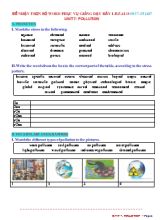
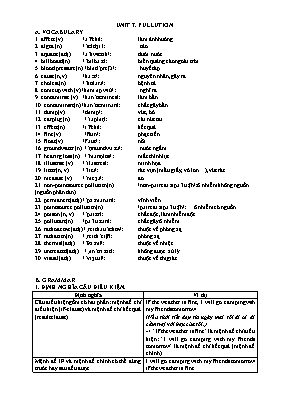
UNIT 7. PULLUTION A. VOCABULARY 1. affect (v) /əˈfekt/: làm ảnh hưởng 2. algea (n) /ˈældʒiː/: tảo 3. aquatic (adj) /əˈkwætɪk/: dưới nước 4. billboard (n) /ˈbɪlbɔːd/: biển quảng cáo ngoài trời 5. blood pressure (n) /blʌd ˈpreʃə/: huyết áp 6. cause (n,v) /kɔːz/: nguyên nhân, gây ra 7. cholera (n) /ˈkɒlərə/: bệnh tả 8. come up with (v) /kʌm ʌp wɪð/: nghĩ ra 9. contaminate (v) /kənˈtæmɪneɪt/: làm bẩn 10. contaminant (n) /kənˈtæmɪnənt/: chất gây bẩn 11. dump (v) /dʌmp/: vứt, bỏ 12. earplug (n) /ˈɪəplʌɡ/: cái nút tai 13. effect (n) /ɪˈfekt/: kết quả 14. fine (v) /faɪn/: phạt tiền 15. float (v) /f əʊt/: nổi 16. groundwater (n) /ˈɡraʊndwɔːtə/: nước ngầm 17. hearing loss (n) /ˈhɪərɪŋ lɒs/: mất thính lực 18. illustrate (v) /ˈɪləstreɪt/: minh họa 19. litter (n, v) /ˈlɪtə/: rác vụn (mẩu giấy, vỏ lon…), vứt rác 20. measure (v) /ˈmeʒə/: đo 21. non-point source pollution (n) /nɒn-pɔɪnt sɔːs pəˈluːʃn/: ô nhiễm không nguồn (nguồn phân tán) 22. permanent (adj) /ˈpɜːmənənt/: vĩnh viễn 23. point source pollution (n) /pɔɪnt sɔːs pəˈluːʃn/: ô nhiễm có nguồn 24. poison (n, v) /ˈpɔɪzn/: chất độc, làm nhiễm độc 25. pollutant (n) /pəˈluːtənt/: chất gây ô nhiễm 26. radioactive (adj) /ˌreɪdiəʊˈæktɪv/: thuộc về phóng xạ 27. radiation (n) /ˌreɪdiˈeɪʃn/: phóng xạ 28. thermal (adj) /ˈθɜːml/: thuộc về nhiệt 29. untreated (adj) /ˌʌnˈtriːtɪd/: không được xử lý 30. visual (adj) /ˈvɪʒuəl/: thuộc về thị giác
B. GRAMMAR 1. ĐỊNH NGHĨA CÂU ĐIỀU KIỆN.
Định nghĩa Ví dụ Câu điều kiện gồm có hai phần: mệnh đề chỉ điều kiện (if-clause) và mệnh đề chỉ kết quả (result clause)
If the weather is fine, I will go campingwith my friends tomorrow. (Nếu thời tiết đẹp thì ngày mai tôi đi sẽ đi cắm trại với bạn của tôi.) -> “If the weather is fine” là mệnh đề chỉ điều kiện: “I will go camping with my friends tomorrow” là mệnh đề chỉ kết quả (mệnh đề chính) Mệnh đề IF và mệnh đề chính có thể đứng trước hay sau đều được.
I will go camping with my friends tomorrow if the weather is fine.
DeThi.edu.vn
II. ÔN TẬP CÂU ĐIỀU KIỆN LOẠI 1 (CONDITIONAL SENENCES TYPE 1) Chức năng Dùng để diễn tả điều kiện có thể xảy ra ở hiện tại hoặc tương lai. Cấu trúc If + S+ V (s/es) + (bổ ngữ) S will +Vnguyên mẫu + (bổ ngữ) (thì hiện tại đơn) (thì tương mai đơn) -> Mệnh đề IF dùng thì hiện tại đơn, mệnh đề chính dùng thì tương lai. Ví dụ If I have enough money, I will buy a new computer. (Nếu tôi có đủ tiền thì tôi sẽ mua một chiếc máy tính mới.) - If you work hard, you will make a lot of money. (Nếu bạn làm việc chăm chỉ thì bạn sẽ kiếm được nhiều tiền.) Lưu ý Unless= If not If= Unless + not Ví dụ: - If he doesn’t do his homework, his mother will complain. -> Unless he does homework, his mother will complain. - If you don’t send to the hospital, she will die. -> Unless you send her to the hospital, she will die. Có thể dùng các động từ must, have to, can, may, should thay cho will trong mệnh đề chính. Ví dụ: Is It rains heavily, you can stay here. (Nếu trời mưa bạn có thể ở lại đây.) - If you want to see that film, you must buy a ticket. (Nếu bạn muốn xem bộ phim đó thì bạn phải mua vé.)
BÀI TẬP VẬN DUNG CƠ BẢN Bài 1. Khoanh tròn phương án đúng để hoàn thành các câu sau. 1. If the weather is fine, we (goes/ will go) camping tomorrow. 2. My parents will give me a gift if I (will pass/ pass) the final exam. 3. If you are polite to others, they (will be/ are nice to you). 4. Unless James (studies/ will study) hard, he will fail the exam. 5. My parents won’t allow me to go out if I (don’t finish/ won’t finish) my homework. 6. If the cable TV (doesn’t/ won’t) work, we will rent a DVD. 7. If you don’t want to stay at home, you (go/ can go) with me to the supermarket. 8. If you (will be/ are) a good listener, you will gain many friends. 9. James won’t attend the meeting if he (won’t/doesn’t) want to. 10. You can’t have this job unless you (have/will have) long working experience. 11. What (you will do/ will you do) if it snows tomorrow? 12. You (will be/ are) able to understand it you practice every day. …
Trên đây là phần đầu tài liệu — bấm Đọc sách để xem đầy đủ.