
Bài tập Tiếng Anh 8 - Unit 1+2
Xem trước nội dung
ENGLISH 8-U1 Page 1
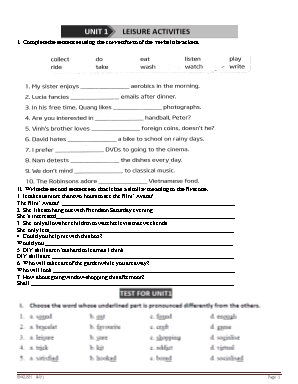
I. Complete the sentences using the correct form of the verbs in brackets.
II. Write the second sentence so that it has a similar meaning to the first one. 1. It takes us more than two hours to see the film “Avatar”. The film “Avatar” ___________________________________________________________ 2. She likes to hang out with friends on Saturday evening. She’s interested _____________________________________________________________ 3. She only allows her children to watch television at weekends. She only lets _______________________________________________________________ 4. Could you help me with this box? Would you ________________________________________________________________ 5. DIY skills aren’t as hard to learn as I think. DIY skills are ______________________________________________________________ 6. Who will take care of the garden while you are away? Who will look ______________________________________________________________ 7. How about going window-shopping this afternoon? Shall _____________________________________________________________________
DeThi.edu.vn
ENGLISH 8-U1 Page 2
III. Write the correct form or tense of the verbs in brackets. 1. At present, the social networks ______________ (become) more popular among young generation. 2. I ______________ (not listen) to their new CD yet. Is it any good? 3. When I was a student, I ______________ (not like) doing homework. 4. Facebook ______________ (found) in 2004 by Mark Zuckerberg and Eduardo Saverin. 5. The American ______________ (spend) 34 hours a week watching television. 6. ______________ (you/ ever/ make) origami cranes? 7. I’ve just bought a new CD of folk songs. I ______________ (listen) to it tonight. 8. Do you adore ______________ (lie) in a hot bath? 9. Please try ______________ (arrive) punctually at 8.30. 10. Many teenagers prefer ______________ (watch) TV to ______________ (read) books.
DeThi.edu.vn
ENGLISH 8-U1 Page 3
III. Underline the correct form of the word. 1. We’ve all been working very hard / hardly and now we’re tired 2. Our school Internet connection is really slow / slowly. 3. What’s the matter with him? He looks angry / angrily. 4. The children are playing quiet / quietly in the garden. 5. Rural areas are common / commonly known as the countryside or a village. 6. Nomadic children are very brave / bravely to learn to ride a horse at the age of five. 7. The sun is shining bright / brightly through the trees. 8. We all find living in the city very stressful / stressfully. 9. Don’t talk so fast / fastly– I can’t understand what you’re saying. 10. John was a kindly and generous / generously man. IV. Complete the dialogue with the comparative form of the adjectives in brackets. David: How do you like living in the big city? Maria: There are many things that are (1) ______________ (good) than living in the country! David: Can you give me some examples? Maria: Well, it certainly is (2) ______________ (interesting) than the country: Thereis so much more to do and see! David: Yes, but the city is (3) ______________ (dangerous) than the counting Maria: That’s true. People in the countryside are (4) ______________ (friendly) thanthose in the city. David: I’m sure that the country is (5) ______________ (relaxed), too! Maria: Yes, the city is (6) ______________ (busy) than the country. However, the country is much (7) ______________ (slow) than the city. David: I think that’s a good thing! Maria: The country is so slow and boring! It’s much (8) ___________ (boring) than the city. David: Life in the country is a lot (9) ______________ (healthy) than in the city, I think. Maria: Sure, it’s (10) ____________ (clean) too. But, the city is so much (11) ____________ (exciting). V. Complete the sentences with the comparative form of adverbs in the box. Add ‘than’ where necessary.
1. The teacher spoke ___________ to help us to understand. 2. She answered all the questions __________ the other students and she got a very good …
Trên đây là phần đầu tài liệu — bấm Đọc sách để xem đầy đủ.