.jpg)

Xem trước nội dung
Full name: ...............................................
Class: ......................................................
ENGLISH LANGUAGE TEST
Unit 1;2;3
Time: 45 minutes
I. LISTENING
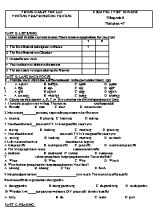
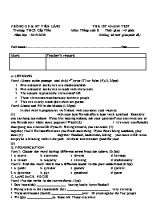
1. Listen to the conversation about living in the countryside in Japan. Circle A, B or C to answer each question. You will listen TWICE.
1. Where is Sam living now?
A. in England B. in Japan C. in Europe
2. What does he like about the village?
A. the mountains B. the ocean C. the pollution
3. How does he feel about the people in the village?
A. difficult B. friendly C. easy
4. Which among these is true about Sam's attitude towards the weather in the village?
A. He likes it very much.
B. He thinks it is comfortable.
C. He hates it.
5. What is the most unusual about the village in Sam's opinion?
A. There are many snakes.
B. All snakes are green.
C. Snakes like to stay in his office.
2. Listen to a talk about living in the countryside. Fill each of the gaps with no more than TWO words. You will listen TWICE.
1. When you live in the countryside, you can enjoy the _____________ surroundings.
2. The city lacks space for _____________ activities.
3. In the city you may not know your _____________ neighbour's name.
4. The _____________ is not too high in the countryside.
5. The low _____________ rate is important for families with small children.
II. READING
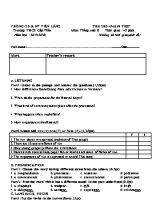
1. Read the passage and decide whether the sentences are true (T) or false (F). Circle T or F.
The Gong culture in the Highlands of Viet Nam The Gong culture is considered to originate from the ancient Dong Son civilization in Southeast Asia. However, the gongs of Viet Nam are special and different in the way they are played. The gongs are made of bronze or a mixture of brass, gold, silver, and bronze. It is round in shape with a diameter ranging from 20cm to 60cm. Larger ones may be from 90cm to 120cm. The gongs often go in set. Each set has from two to thirteen gongs and each is played by one man or woman. When they play, they arrange the order and the sounds in different ways to create very special rhythms.
DeThi.edu.vn
Long time ago, the gongs were played on the occasion of the new rice season or rice harvest. Now the ethnic groups play the gongs on any important festivals or ceremonies. The gongs have become musical instruments of sacred power of many ethnic groups in Viet Nam.
1. The Gong culture has origin from Dong Son civilization. T F
2. The average gong has a diameter ranging from 20cm to 60cm. T F
3. The gongs are played in set to create special rhythms. T F
4. The gongs are played only during most important festivals. T F
5. The Gong culture has become important to ethnic groups in Viet Nam. T F
2. Read the passage. Circle A, B or C to answer each question.
The Tay live mainly in the Northeastern part of Viet Nam. They live in large and crowded villages with hundreds of houses. They live in houses built on stilts. They are mainly farmers and they grow rice on terraced fields. They also raise cattles and poultry. Tay traditional dress is made from homegrown cotton. There is usually not much embroidery or other decorations. Women wear skirts or trousers, with short shirts inside and long one on the outside. They have many festivals and holidays in a year. The Lunar New Year and the mid-July festivals are the most lavishly organized. During festivals, people in many places play con throwing, badminton, tug-of-war, dragon dancing, or chess. The Tay eat mainly sticky rice. On festival occasions, they make many kinds of cakes, such as banh chung(sticky rice square cakes), banh day (sticky rice round cakes) or banh khao (cakes made of white rice flour).
1. Which of the following best describes the main idea of the passage?
A. The Tay live in the Northeastern part of Viet Nam.
B. The Tay make many kinds of cakes on festival occasions.
C. The Tay have many festivals and holidays in a year.
D. The life of the Tay in Viet Nam.
2. What do the Tay mainly …
Trên đây là phần đầu tài liệu — bấm Đọc sách để xem đầy đủ.
 - Nam hoc 2019-2020 - Tru.jpg "Bộ đề kiểm tra môn Tiếng Anh Lớp 8 (Trong thời gian nghỉ do dịch Covid-19) - Năm học 2019-2020 - Trường THCS Trần Hưng Đạo")