.jpg)

Xem trước nội dung
Full name: ...............................................
Class: ......................................................
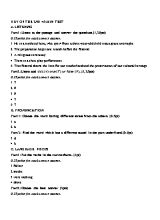
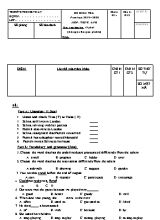
ONE-PERIOD TEST No 2 (Units 4 & 5)-GRADE 8
THE 1ST SEMESTER
I. LISTENING
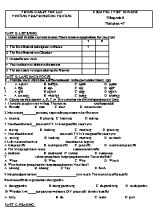
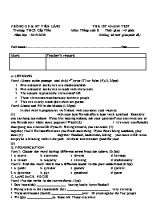
1. Listen to the conversation between two friends. Decide if the statements are true (T) or false (F). Circle T or F.
1. Minh is watching television when Hanh phones. T F
2. Hanh invites Minh to a music festival. T F
3. Minh can’t go rollerblading because she has no rollerblades. T F
4. Hanh suggests going to Museum of Ethnology to paint pottery. T F
5. In the end Hanh goes to the art fair alone. T F
2. Listen to Amy talking about the custom of drinking tea around the world. Match the country with its information. You will listen TWICE.
1. Morocco A. Chai is the national drink here.
2. India B. Matcha is a ceremony here.
3. Japan C. People here drink coffee in the mornings and tea in the evenings.
4. New Zealand D. This country have to import tea from others.
5. USA E. Mint tea is the heart of the culture.
II. READING
1. Read the passage and answer the questions.
"Li xi" is an important part in Vietnam’s customs of Tet Festival, especially with children. It is a small amount of money that can bring good fortune to the upcoming year. However, "li xi" is not limited only on the first day, but can even last to the 9th or 10th day of Tet Festival, and given when the adults first met the kids. Besides the money, the tiny red envelope also has its own meaning. It represents the secrecy and privacy to avoid comparison as adults want children to regard the money as the gift of New Year, instead of being jealous of receiving less than other kids. The red color, the most popular color appearing in Vietnamese festivals, signifies the prosperity and great luck according to Asian’s beliefs. In the morning of the first day of Lunar New Year, children and parents will visit grandparents’ home, wishing for a happy new year and great health, showing respect and gratitude, and giving gifts. After that, it is grandparents and adults’ turn to give children lucky money to welcome their new age.
1. By whom is the custom loved most?
______________________________________
2. For how long can the custom be applied?
______________________________________
3. Why is a red envelope used?
______________________________________
4. What does the red color signify?
______________________________________
5. Why do adults give "li xi" to children?
______________________________________
2. Read the passage. Circle A, B or C to answer each question or complete each sentence.
DeThi.edu.vn
The meaning of Mid-Autumn Day is rather different to that in China, though the Vietnamese also celebrate it by eating mooncakes. In Viet Nam the Mid-Autumn Festival is the happiest day for children, during which parents buy their children various kinds of lanterns and snacks. There are also various activities held to celebrate the Mid-Autumn Festival in Viet Nam. The main activities include worshipping the God of Earth, and carrying carp-shaped lanterns. Usually a worshipping platform is set up in the yard during Mid-Autumn night, on which mooncakes, fruits, and snacks are laid. Later family members sit to gether to eat the food while appreciating the moon. It's also a tradition for the Vietnamese to light lanterns during the Mid-Autumn night. It is thought that if people walk at night with a carp lantern in hand, they will be safe from the carp spirit. Now, children hold various kinds of paper lanterns and play in the moonlight, while eating mooncakes during the evening of Mid-Autumn Day.
1. What is Vietnamese Mid-Autumn festival different from that of China in?
A. time B. food C. meaning
2. Parents buy children all of these things EXCEPT _________.
A. mooncakes B. carps C. lanterns
3. What are the main activities in Vietnamese Mid-Autumn Festival?
A. worshipping the God of Earth
B. carrying carp-shaped lanterns
C. Both A and B
4. Why do children …
Trên đây là phần đầu tài liệu — bấm Đọc sách để xem đầy đủ.
 - Nam hoc 2019-2020 - Tru.jpg "Bộ đề kiểm tra môn Tiếng Anh Lớp 8 (Trong thời gian nghỉ do dịch Covid-19) - Năm học 2019-2020 - Trường THCS Trần Hưng Đạo")