.jpg)

Xem trước nội dung
1
ĐỀ THI CUỐI HỌC KÌ 2
LỚP 9
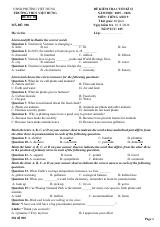
1. Listen to FIVE short conversations. Choose the main topic of each conversation. Circle A, B or C. You will listen TWICE.
1. What is the conversation about? A. Future career. B. Future technology. C. A better world. 2. What are the speakers talking about? A. Doing a business. B. A study plan. C. A personal goal. 3. What is the conversation about? A. Why men and women are different. B. Why more and more women work.
C. Why management is more suitable for women.
4. What is the conversation about? A. Future career. B. Working with women. C. A women’s daily routine. 5. What is the conversation about? A. A physics class. B. A physics teacher. C. Virtual field trips.
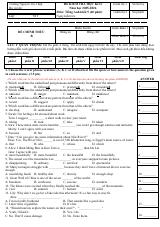
2. Listen to a talk about monkey nauts. Fill each of the gaps with NO MORE THAN TWO WORDS. You will listen TWICE.
Monkeynauts which are monkey (1)___________ were also sent into space. The first monkey that was sent into sub-orbital space was a squirrel monkey called Gordo on (2)__________ 1958, in the nose cone of a US Army Jupiter AM-13 rocket. Gordo did well in the flight, but it drowned in the (3)__________ when the flotation device failed and sank. Able and Baker were the next two monkeys that (4)____________ in space on May 28, 1959 on the Jupiter AM-18 rocket. They were both successfully retrieved after a flight of 300 miles which took 16 minutes. However, Able died four days after the flight and Baker died of kidney (5)_____________ 25 years after the flight, at the age of 27.
II. READING
1. Read the passage. Circle A, B or C to answer each question.
First explorations into the planets
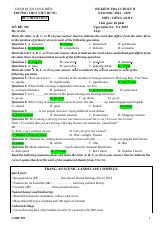
Human’s dream of stepping into the outer space has been long ago and Jules Verne - a famous fiction writer of the 19th century was the first to describe such journeys. However, it was not until 14 September 1959 when the first artificial object - Lunar 2 - reached the moon. It was a journey of around 36 hours. Then on 3 February 1966 Luna 9 - an unmanned space mission - achieved a soft landing on the moon and transmitted photographic data to Earth. Lunar 10 - a robotic spacecraft mission entered lunar orbit on April 3, 1966. On 20 July 1969, the first manned landing on the moon was made by Neil Armstrong. After his journey, a series of journeys to other planets were made. The first flyby - the flight of a spacecraft near a planet to record data - of Venus was made by Mariner 2 in 1962. Other flybies include that in 1965 for Mars by Mariner 4, 1973 for Jupiter by Pioneer 10, 1974 for Mercury by Mariner 10, 1979 for Saturn by Pioneer 11, 1986 for Uranus by
NO 4
DeThi.edu.vn
2
Voyager 2, 1989 for Neptune by Voyager 2.
1. Jules Verne was the first ______.
A. to dream of flying into space B. to enter the moon
C. to describe space journeys
2. Lunar 2 was the first artificial object to ______.
A. orbit the moon B. reach the moon C. land on the moon
3. Lunar 9 ______.
A. was launched eight years after Lunar 2 B. was launched with a human
C. could send photographic data to Earth
4. According to the passage, which of the following is NOT true of Lunar 10?
A. It was launched with a robot. B. It was launched in the same year with Lunar 9.
C. It landed on the moon.
5. A flyby is a flight of a spacecraft ______.
A. near Venus, Mars and Mercury to take pictures
B. made near a planet to gain data of the planet
C. made in 1962, 1974 and 1898
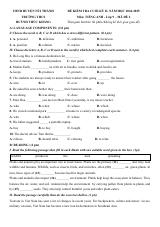
2. Read the passage about space. Decide if the statements are true (T) or false (F). Circle T or F.
In the past, the study of space was mainly carried out by astronomers using telescopes. However, astronomers sometimes had it wrong. Meanwhile, apart from the desire to conquer the world around, humans also want more space to accommodate the world’s increasing population. Owing to the developments in space technology, humans have made spectacular explorations and discoveries of the space. The explorations can be conducted either by unmanned robotic probes or by human spaceflights. Undeniably, those …
Trên đây là phần đầu tài liệu — bấm Đọc sách để xem đầy đủ.