
Xem trước nội dung
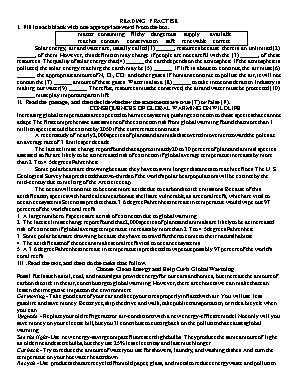
READING PRACTISE I. Fill in each blank with one appropriate word from the box.
matter consuming filthy dangerous supply available reaches contain conservation safe renewable correct Solar energy, air and water are, usually called (1) ______, resources because there is an unlimited (2) ______, of them. However, this definition may change if people are not careful with the (3) ______, of these resources. The quality of solar energy that (4) ______ the earth depends on the atmosphere. If the atmosphere is polluted, the solar energy reaching the earth may be (5) ______. If life is about to continue, the air must (6) ______ the appropriate amount of N, O2, CO2 and other gases. If humans continue to pollute the air, it will not contain the (7) ______ amount of these gases. Water is also a (8) ______ to take into consideration. Industry is making our water (9) ______. Therefore, resources must be conserved, the air and water must be protected. (10) ______ must play important part in life. II. Read the passage, and then decide whether the statements are true (T) or false (F). CONSEQUENCES OF GLOBAL WARMING ON WILDLIFE Increasing global temperatures are expected to harm ecosystems, pushing extinction to those species that cannot adapt. The first comprehensive assessment of the extinction risk from global warming found that more than 1 million species could be extinct by 2050 if the current rate continues. A recent study of nearly 2,000 species of plants and animals discovered movement toward the poles at an average rate of 3.8 miles per decade.
The latest climate change report found that approximately 20 to 30 percent of plant and animal species assessed so far are likely to be at increased risk of extinction if global average temperature increases by more than 2.7 to 4.5 degrees Fahrenheit. Some polar bears are drowning because they have to swim longer distances to reach ice floes. The U. S. Geological Survey has predicted that two-thirds o f the world's polar bear populations will be extinct by the mid-century due to melting of the Arctic ice cap. The ocean will continue to become more acidic due to carbon dioxide emissions. Because of this acidification, species with hard calcium carbonate shells are vulnerable, as are coral reefs, which are vital to ocean ecosystems. Scientists predict that a 3.6 degree Fahrenheit increase in temperature would wipe out 97 percent of the world's coral reefs. 1. A large number o f species are at risk of extinction due to global warming. 2. The latest climate change report found that 2,000 species of plants and animals are likely to be at increased risk of extinction if global average temperature increases by more than 2.7 to 4.5 degrees Fahrenheit. 3. Some polar bears are drowning because they have to travel farther to come to their natural habitat. 4. The acidification of the oceans makes coral reefs vital to ocean ecosystems. 5. A 3.6 degree Fahrenheit increase in temperature is predicted to wipe out possibly 97 percent of the world's coral reefs. III .Read the text, and then do the tasks that follow. Choose Clean Energy and Help Curb Global Warming Fossil fuels such as oil, coal, and natural gas provide energy for our cars and homes, but increase the amount of carbon dioxide in the air, contributing to global warming. However, there are choices we can make that can lessen their negative impact on the environment. Get moving - Take good care of your car and keep your tires properly inflated with air. You will use less gasoline and save money. Better yet, skip the drive and walk, take public transportation, or ride a bicycle when you can. Upgrade - Replace your old refrigerator or air-conditioner with a new energy-efficient model. Not only will you save money on your electric bill, but you’ll contribute to cutting back on the pollution that causes global warming. See the light - Use new energy-saving compact fluorescent light bulbs. They produce the same amount of light as older incandescent …
Trên đây là phần đầu tài liệu — bấm Đọc sách để xem đầy đủ.