
Xem trước nội dung
Thẩm Tâm Vy, December 04th, 2019 IDIOMATIC AMERICAN ENGLISH - (12).
IDIOMATIC AMERICAN ENGLISH 12
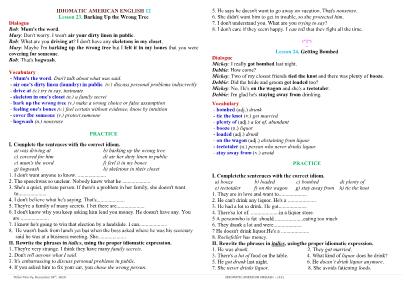
Lesson 23. Barking Up the Wrong Tree Dialogue Bob: Mum's the word. Mary: Don't worry. I won't air your dirty linen in public. Bob: What are you driving at? I don't have any skeletons in my closet. Mary: Maybe I'm barking up the wrong tree but I felt it in my bones that you were covering for someone. Bob: That's hogwash. Vocabulary - Mum's the word. Don't talk about what was said. - air one's dirty linen (laundry) in public (v.) discuss personal problems indiscreetly - drive at (v.) try to say, insinuate - skeleton in one's closet (n.) a family secret - bark up the wrong tree (v.) make a wrong choice or false assumption - feeling one's bones (v.) feel certain without evidence, know by intuition - cover fbr someone (v,) protect someone - hogwash (n.) nonsense
PRACTICE
I. Complete the sentences with the correct idiom. a) was driving at b) barking up the wrong tree c) covered for him d) air her dirty linen in public e) mum's the word f) feel it in my bones g) hogwash h) skeletons in their closet 1. I don't want anyone to know. ..................... 2. The speechwas so unclear. Nobody knew what he ..................... 3. She's a quiet, private person. If there's a problem in her family, she doesn't want to..................... 4. I don't believe what he's saying. That's..................... 5. They're a family of many secrets. I bet there are..................... 6. I don't know why you keep asking him lend you money. He doesn't have any. You are ..................... 7. I know he's going to win that election by a landslide. I can..................... 8. He wasn't back from lunch yet but when the boss asked where he was his secretary said he was at a business meeting. She..................... II. Rewrite the phrases in italics, using the proper idiomatic expresston. 1. They're very strange. I think they have many family secrets. 2. Don't tell anyone what I said. 3. It's embarrassing to discuss personal problems in public. 4. If you asked him to fix your car, you chose the wrong person.
5. He says he doesn't want to go away on vacation. That's nonsense. 6. She didn't want him to get in trouble, so she protected him. 7. I don't understand you. What are you trying to say? 8. I don't care if they seem happy. I can tell that thev fight all the time.
(*||*)
~ Lesson 24. Getting Bombed Dialogue Mickey: I really got bombed last night. Debbie: How come? Mickey: Two of my closest friends tied the knot and there was plenty of booze. Debbie: Did the bride and groom get loaded too? Mickey: No. He's on the wagon and she's a teetotaler. Debbie: I'm glad he's staying away from drinking. Vocabulary - bombed (adj.) drunk - tie the knot (v.) get married - plenty of (adj.) a lot of, abundant - booze (n.) liquor - loaded (adj.) drunk - on the wagon (adj.) abstaining from liquor - teetotaler (n.) person who never drinks liquor - stay away from (v.) avoid
PRACTICE
I. Completethe senteruces with the correct idiom. a) booze b) loaded c) bombed d) plenty of e) teetotaler f) on the wagon g) stay away from h) tie the knot 1. They are in love and want to..................... 2. He can't drink any liquor. He's a ..................... 3. He had a lot to drink. He got..................... 4. There'sa lot of. .....................in a liquor store. 5 A personwho is fat should .....................eating too much 6. They drank a lot and were..................... 7 He doesn't drink liquor.He's a ..................... 8. Rockefeller has money. II. Rewrite the phrases in italics, usingthe proper idiomatic expression. 1. He was drunk. 2. They got married. 3. There's a lot of food on the table. 4. What kind of liquor does he drink? 5. He got drunk last night. 6. He doesn’t drink liquor anymore. 7. She never drinks liquor. 8. She avoids fattening foods.
DeThi.edu.vn
Trên đây là phần đầu tài liệu — bấm Đọc sách để xem đầy đủ.