
Xem trước nội dung
Thẩm Tâm Vy, June 27th, 2019 PRACTISE AMERICAN ENGLISH
IDIOMATIC AMERICAN ENGLISH
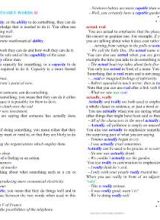
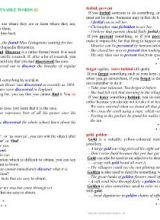
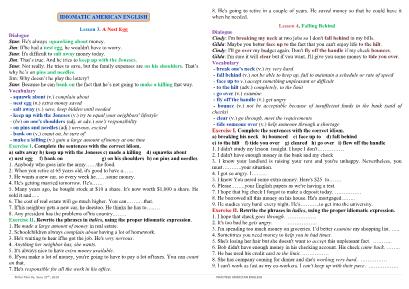
Lesson 3. A Nest Egg Dialogue Stan: He's always squawking about money. Jim: If'he had a nest egg, he wouldn't have to worry. Stan: It's difficult to salt away money today. Jim: That’s true. And he tries to keep up with the Joneses. Stan: Not really. He tries to save, but the family expenses are on his shoulders. That’s why he’s on pins and needles. Jim: Why doesn’t he play the lottery? Stan: Because he can bank on the fact that he’s not going to make a killing that way. Vocabulary - squawk about (v.) complain about - nest egg (n.) extra money saved - salt away (v.) save, keep hidden until needed - keep up with the Joneses (v.) try to equal your neighbors' lifestyle - (be) on one's shoulders (adj. or adv.) one's responsibility - on pins and needles (adj.) nervous, excited - bank on (v.) count on, be sure of' - make a killing (v.) gain a large amount of'money at one time Exercise I. Complete the sentences with the correct idiom. a) salts away b) keep up with the Joneses c) made a killing d) squawks about e) nest egg f) bank on g) on his shoulders h) on pins and needles 1. Anybody who goes into the army……the food. 2. When you retire at 65 years old, it's good to have a…… 3. He wants a new car, so every week he……some money. 4. He's getting married tomorrow. He's…… 5. Many years ago, he bought stock at $10 a share. It's now worth $1,000 a share. He sold it and….. 6. The cost of real estate will go much higher. You can……….that. 7. If'his neighbor gets a new car, he doestoo. He thinks he has to…..… 8. Any president has the problems of'his country.……. Exercise II. Rewrite the phrascs in italics, using the proper idiomatic expression. 1. He made a large amount of money in real estate. 2. Schoolchildren always complain about having a lot of homework. 3. He's waiting to hear if'he got the job. He's very nervous. 4. Anything her neighbor has, she wants. 5. It's always nice to have extra money available. 6. If'you make a lot of money, you're going to have to pay a lot of'taxes. You can count on that. 7. He's responsible for all the work in his office.
8. He's going to retire in a couple of years. He saved money so that he could have it when he needed.
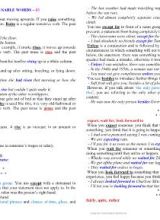
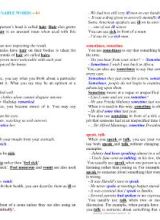
Lesson 4. Falling Behind Dialogue Cindy: I'm breaking my neck at two jobs so I don't fall behind in my bills. Gilda: Maybe you better face up to the fact that you can't enjoy life to the hilt. Cindy: I'll go over my budget again. Don't fly off the handle if my check bounces. Gilda: I'm sure it will clear but if vou want, I'll give you some money to tide you over. Vocabulary - break one's neck (v.) try very hard - fall behind (v.) not be able to keep up, fail to maintain a schedule or rate of speed - face up to v.) accept something unpleasant or difficult - to the hilt (adv.) completely, to the limit - go over (v.) examine - fly off'the handle (v.) get angry - bounce (v.) not be acceptable because of insufficient funds in the bank (said of checks) - clear (v.) go through, meet the requirements - tide someone over (v.) help someone through a shortage Exercise I. Complete the sentences with the correct idiom. a) breaking his neck b) bounced c) face up to d) fall behind e) to the hilt f) tide you over g) cleared h) go over i) flew off the handle 1. I didn't study my lesson tonight. I hope I don't…………… 2. I didn't have enough money in the bank and my check 3. I know your landlord is raising your rent and you're unhappy. Nevertheless, you must………..your situation. 4. I got so angry. I……… 5. I know You nered some extra money. Here's $25 to……. 6. Please……..your English papers as we're having a test. 7. I hope that big check I forgot to make a deposit today. …………… 8. He borrowed all this money on his house. He's mortgaged…….. 9. He studies very hard every night. He's………..to get into the university. Exercise II. Rewrite the phrases in italics, using the proper idiomatic expression. 1. I hope that check goes through. …
Trên đây là phần đầu tài liệu — bấm Đọc sách để xem đầy đủ.