
Những từ gây nhầm lần trong Tiếng Anh - Phần 12 - Thấm Tâm Vy
Xem trước nội dung
Thẩm Tâm Vy, September 02, 2020 ENGLISH CONFUSABLE WORDS 12
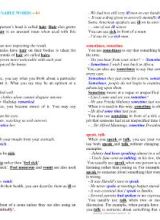
ENGLISH CONFUSABLE WORDS – 12 worth, value If something is worth an amount of money, that is the amount you would get for it tf you sold it. - The lens alone was worth about £100. - Two chairs like that must be worth at least a thousand pounds up in London. In formal or literary English, you can talk about the worth of a person, meaning their usefulness, or importance. - ...true knowledge of the other’s worth and a profound awareness of their individual existence. - This job has robbed me of all worth. You can also use value to talk about how useful or important a person is. Value is also used with things such as qualities and plans. - She is beautiful, but my concerns are ofher true value as my son’s wife. Is she a strong, hard worker? - Everyone realizes the value ofsincerity. - Their task was to ensure that no information ofpositive military value to the enemy was sent out. When you talk about the value of something that you can own such as a house or car, you mean the amount of money that someone will pay for it. You do not talk about the 'worth' of something that someone owns. - What would you say is the value of this property today? - They paid 28 percent above market value for it. - The value of the horse is now in excess of £500,000.
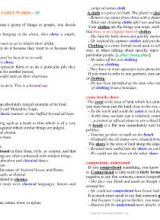
wood, woods, forest A wood is a large area of trees growing close to each other. - It was cool and dark inside the wood. - At last we entered the cool beech wood through which the Squire’s drive twisted. - I told her I had heard her talking in the wood. If you talk about a particular wood, you can also call it ‘the woods’. - I have to search the woods for hazel branches. - ...a brisk walk through the nearby woods. - We rushed out of the woods and down the hill. A forest is an extremely large area of trees. Forests are usually a long way from towns and cities. - They had their picnic in a clearing in the forest. - This would destroy the Amazon forest, believed to provide a quarter of the world’s oxygen supply. whole, all Whole is used to describe something that is being considered as a complete, single thing, rather than being considered to be made up of a set of individual parts. As an
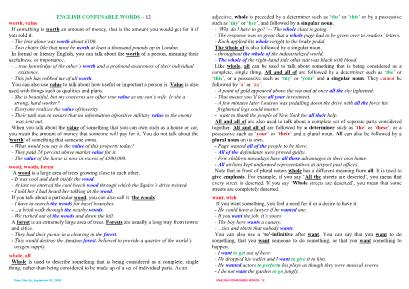
adjective, whole is preceded by a determiner such as ‘the’ or ‘this’ or by a possessive such as ‘my’ or ‘her’, and followed by a singular noun. - ‘Why do I have to go?’—‘The whole class is going. ’ - The response was so great that a whole page had to be given over to readers’ letters. - Koch applied his whole weight to the brake pedal. The whole of is also followed by a singular noun. - throughout the whole of the industrialized world. - The whole of the right-hand side ofhis suit was black with blood. Like whole, all can be used to talk about something that is being considered as a complete, single thing. All and all of are followed by a determiner such as ‘the’ or ‘this’, or a possessive such as ‘my’ or ‘your’ and a singular noun. They cannot be followed by ‘a’ or ‘an’. - A point of gold appeared above the sea and at once all the sky lightened. - That means you’ll lose all your investment. - A few minutes later Louison was pedalling down the drive with all the force his frightened legs could muster. - want to thank the people of New York for all their help. All and all of are also used to talk about a complete set of separate parts considered together. All and all of are followed by a determiner such as ‘the’ or ‘these’, or a possessive such as ‘your’ or ‘their’ and a plural noun. All can also be followed by a plural noun on its own. - Page wanted all of the people to be there. - All of the defendants were proved guilty. - Few children nowadays have all these advantages in their own home. - All airlines kept uniformed representatives at airport post offices. Note that in front of plural nouns whole has a different meaning from all. It is used to give emphasis. For example, if you say ‘All the streets are deserted’, you mean that every street …
Trên đây là phần đầu tài liệu — bấm Đọc sách để xem đầy đủ.