
Đề cương ôn tập học kỳ II môn Tiếng Anh Lớp 6 - Năm học 2015-2016
Báo tài liệu không phù hợp
Xem trước nội dung
1
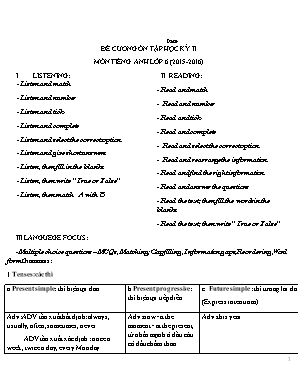
Date ĐỀ CƯƠNG ÔN TẬP HỌC KỲ II
MÔN TIẾNG ANH LỚP 6 (2015-2016)
I. LISTENING: - Listen and match
- Listen and number
- Listen and tick
- Listen and complete
- Listen and select the correct option
- Listen and give short answers.
- Listen, then fill in the blanks.
- Listen, then write “ True or False”
- Listen, then match A with B
II. READING:
- Read and match
- Read and number
- Read and tick
- Read and complete
- Read and select the correct option
- Read and rearrange the information
- Read and find the right information
- Read and answer the questions
- Read the text, then fill the words in the blanks.
- Read the text, then write “ True or False”
III.LANGUEGE FOCUS:
- Multiple choice questions – MCQs, Matching; Gap filling, Information gaps, Reordering,Word form Grammars:
1.Tenses:các thì
a.Present simple: thì hiện tại đơn b.Present progressive: thì hiện tại tiếp diễn
c. Future simple : thì tương lai đơn
(Express intentions)
Adv: ADV tần xuất bất định: always, usually, often, sometimes, never
ADV tần xuất xác định : once a week, twice a day, every Monday
Adv: now=at the moment= at the present, từ nhấn mạnh ở đầu câu có dấu chấm than
Adv: this year
DeThi.edu.vn
2
afternoon, three days a month…….
(+) I /We /You /They + V (nguyên mẫu)
He/She /It + V (thêm s/es) Thêm Es khi âm cuối X,S ,O, C,Sh ,Z
(-) I /We /You /They + don’t + V(nguyên mẫu)
He/She /It + doesn’t + V (nguyên mẫu)
(?) Do + I /We /You /They + V(nguyên mẫu)….?
Does + He/She /It + V (nguyên
mẫu)………?
Ex:- Do you have a new friend?
- She doesn’t believe that the first footer on New Year’s Day decides the family’s lucky for the rest of the year
(+) S + am/is/are + V-ing
(-) S + am not /isn’t /aren’t + V-ing
(?) Am/ Is / Are + S + V-ing..?
Ex:- This evening, we are working on our school project.
- Are you going to the judo club with your brother, now?
(+) S + will + V (nguyên mẫu)
(-) S + won’t+ V (nguyên mẫu)
(?) Will + S + V (nguyên mẫu)…
Ex:
What will you do at Tet?
We will celebrate Tet at the end of January
+ Dùng shall với các chủ ngữ WE/I
Ex: Where shall we go first?
2. Verbs + V-ing : love, hate (ghét), like, dislike (không thích)………………………..(động từ chỉ cảm xúc)
3. Suggestions: cấu trúc gợi ý
-What /How about + V thêm ing….? Còn về việc …thì sao.
-Let’s + V nguyên mẫu: chúng ta hãy….
-Why don’t we/you + Vnguyên mẫu ….? Tại sao chúng ta/bạn không…?
-Shall we + V nguyên mẫu ..? Chúng ta sẽ……
4. Modal verb: động từ khiếm khuyết : can : có thể, must : phải, mustn’t : không được, should = ought to: nên, shouldn’t: không nên, will:sẽ, won’t: sẽ không, [shall: sẽ/shan’t : sẽ không (Đi với chủ ngữ We/I)]………………………….
DeThi.edu.vn
3
5. Danh từ chỉ các bộ phận cơ thể: head, shoulders, chest, fur, face, arms, legs, hair, tail, eyes, nose, ears, hands, finger, knee, elbow, foot feet, tooth teeth,mouth, neck, cheek…
6.Tính từ :tall: cao, short: thấp, thin: ốm, fat: mập, heavy: nặng, light: nhẹ, strong : mạnh, weak: yếu….
7.Các tính từ thường dung để tả ngoại hình: long, short, big, small, round, long, chubby………………………………
Các tính từ chỉ màu sắc : blonde , brown…………………………
Các tính từ chỉ tính cách: independent, active, freedom-loving, patient, reliable, hard-working, talkative, curious, sensitive, caring, intelligent, confident, competitive, creative, careful, helpful, friendly, responsible……………………
8. Sự yêu cầu: Ex: Can you pass me the biscuits please? – Yes, sure
9.
10.Hỏi có cái gì?
Is there any + DT kđđ..? Yes, there is./ No, There isn’t
Are there any /many+ DT đđ số nhiều ..? Yes, there are/ No, there aren’t
Ex: Are there many rooms in your new apartment?
11.Sử dụng động từ (study,have, do, play) + danh từ
12.Chia động từ have: I/we/ you/ they+ have; He/ she/ it + has
13.Câu hỏi Yes /No : Do you like cold drink? Yes ,I do / No, I don’t
Does he like cold drink? Yes ,he does / No, he doesn’t
14. Cách nói muốn: S + would like + (n)/To V …
Câu mời: Would you like ………………? Ex: Would you like to …
Trên đây là phần đầu tài liệu — bấm Đọc sách để xem đầy đủ.








 - Nam hoc 2021-2022.jpg "Đề cương ôn tập học kỳ 2 Tiếng Anh 6 (Chương trình thí điểm) - Năm học 2021-2022")