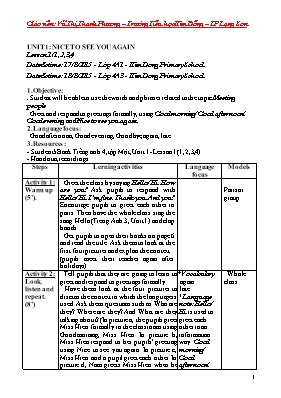

Giáo án Tiếng Anh Lớp 4 - Unit 1 đến 3 - Năm học 2015-2016 - Vũ Thị Thanh Phương
Xem trước nội dung
1
Giáo viên: Vũ Thị Thanh Phương – Trường Tiểu học Kim Đồng – TP Lạng Sơn
UNIT 1: NICE TO SEE YOU AGAIN Lesson 1(1,2,3,4)
Date & time: 17/8/2015 - Lớp 4A1 - Kim Dong Primary School.
Date & time: 18/8/2015 - Lớp 4A3 - Kim Dong Primary School.
1. Objective: . Student will be able to use the words and phrases related to the topic Meeting people . Greet and respond to greetings formally, using Good morning/ Good afternoon/ Good evening and Nice to see you again. 2. Language focus: . Good afternoon, Good evening, Goodbye, again, late. 3. Resources : - Student’s Book Tiếng anh 4, tập Một, Unit 1- Lesson 1(1,2,3,4) - Handouts, recordings.
Steps Lerning activities Language focus
Models
Activity 1: Warm up (5’).
. Greet the class by saying Hello/ Hi. How are you? Ask pupils to respond with Hello/ Hi. I’m fine. Thank you. And you? Encourage pupils to greet each other in pairs. Then have the whole class sing the song Hello (Tieng Anh 3, Unit 1) and clap hands. . Get pupils to open their books on page 6 and read the title. Ask them to look at the first four pictures and explain the context (pupils meet their teacher again after holidays)
Pairs or group
Activity 2: Look, listen and repeat. (8’)
. Tell pupils that they are going to learn to greet and respond to greetings formally. . Have them look at the four pictures to discuss the context in which the language is used. Ask them questions such as Who are they? Where are they? And What are they talking about? (In picture a, the pupils greet Miss Hien formally in the classroom using Goodmorning, Miss Hien. In picture b, Miss Hien respond to her pupils’ greeting using Nice to see you again. In picture c, Miss Hien and a pupil greet each other. In picture d, Nam greets Miss Hien when he
*Vocabulary: . again . late
*Language note: Hello/ Hi is used to greet each other in an information way. Good morning/ Good afternoon/
. Whole class
ThuVienDeThi.com
2
comes into the class late, saying Good morning, Miss Hien.) . Play the recording a few times for pupils to listen and repeat. Do choral and individual repetition, pointing to the characters speaking. . Play the recording again for them to listen and repeat.
Good evening is used to greet each other formally. . Individual
Activity 3: Point and say. ( 7’)
. Tell pupils that they are going to practise greeting and responding to each other formally by using Good morning, Good afternoon and Good evening. . Have them look at the pictures to understand how the language is used in different contexts. Point to the first pictures and elicit the formal greeting used in the morning. Ask them to say the phrase chorally and individually. Then tell them to practise greeting and responding to greetings in pairs, using the prompts in the bubbles. . Repeat the same procedure with the rest of the pictures. . Call a few pairs to act out the dialogue in front of the class. Check as a class correct pronunciation, if necessary. * Greet your teachers in the classroom or at school. . Tell pupils that they are going to practise using Good morning or Good afternoon. . Ask some of them to act out the greetings with you.
*Vocabulary: . Good afternoon . Good evening . Goodbye
. Whole class
. Individual
. Pairs
Activity 4: Listen and tick. (7’)
. Have pupils look at the pictures to identify the similarities and differences. (The pupils and teachers are greeting each other at different times of the day). Check understanding. . Play the recording a few times. Ask pupils to listen the recording and tick the correct pictures. Tell them not to worry if they can’t understand every word, and that they should focus on who Miss Hien is talking to (Dialogue 1), when they are speaking 9 Dialogue 2), and to whom Mai says Goosbye (Dialogue 3). . Get pupils to swap their answers before
. Whole class
. Groups
. Pairs
ThuVienDeThi.com
Trên đây là phần đầu tài liệu — bấm Đọc sách để xem đầy đủ.