
Đề kiểm tra định kỳ lần 1 học kỳ I môn Tiếng Anh Lớp 10 - Đề 320 - Năm học 2015-2016 - Trường THPT Ninh Quới (Có đáp án)
Báo tài liệu không phù hợp
Xem trước nội dung
trang 1- đề 320
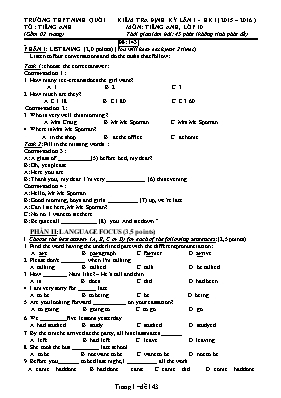
TRƯỜNG THPT NINH QUỚI KIỂM TRA ĐỊNH KỲ LẦN 1 - HK I ( 2015 – 2016 ) TỔ : TIẾNG ANH MÔN: TIẾNG ANH, LỚP 10 (Gồm 02 trang) Thời gian làm bài: 45 phút (không tính phát đề) Đề: 320 PHẦN I: LISTENING (2,0 points) (You will hear each part 2 times) Listen to four conversations and do the tasks that follow:
Task 1: choose the correct answer: Conversation 1: 1. How many ice-creams does the girl want? A. 1 B. 2 C. 3 2. How much are they? A. £ 1.18 B. £ 1.80 C. £ 3.60 Conversation 2: 3. Who is very well this morning ? A. Mrs Craig B. Mr Mc Sporran C .Mrs Mc Sporran 4. Where is Mrs Mc Sporran? A. in the shop B . at the office C. at home Task 2: Fill in the missing words : Conversation 3: A: A glass of ___________(5) before bed, my dear? B: Oh, yes please. A: Here you are. B: Thank you, my dear. I’m very _____________ (6) this evening . Conversation 4: A: Hello, Mr Mc Sporran. B: Good morning, boys and girls. __________ (7) up, we’re late. A: Can I sit here, Mr Mc Sporran? C: No no. I want to sit there. B: Be quiet all ____________ (8) you. And sit down."
PHẦN II: LANGUAGE FOCUS (3,5 points) I. Choose the best answer (A, B, C or D) for each of the following sentences: (2,5 points) 1. Find the word having the underlined part with the different pronunciation: A. are B. arrive C. paragraph D. farmer 2. Please don't ________ when I'm talking. A. talking B. talked C. talk D. be talked 3. She took the bus _________ late school. A. to be B. not to be C. want to be D. not want to be 4. I am very sorry for ______ late. A. be B. being C. to be D. been 5. Are you looking forward ___________ on your cassation?
A. to going . B. going to C. to go D. go 6. How ________ Nam like? – He’s tall and thin. A. does B. did C. had been D. is 7. By the time he arrived at the party, all his classmates _______.
A. had left B. leave C. left D. leaving 8. We _________five lessons yesterday.
A. studyed B. had studied C. study D. studied 9. Before you_______ to bed last night, I __________ all the work.
A. come…had done B. had done …..came C. came…did D. came…had done
ThuVienDeThi.com
trang 2- đề 320
10. Three women, none of whom we ________ before, ________ out of the hall. A. saw…came B. had seen…came C. saw…had come D. had seen…had come
II. Match the word in A with a suitable definition in B: (1,0 point)
A B 1. with flying colours a. contented with 2. a quarter b. successfully 3. ease c. a period of 15 minutes 4. satisfied with d. make less severe PHẦN III: READING (2,5 points) 1. Read the passage and then choose the best answer. Parents send their children to the school to prepare for the time when they grow up. Children learn their native language so that they will be able to communicate fluently with other people around them. Moreover, they can preserve the valuable culture and literature of their country. They learn foreign languages in order to benefit from other countries’ heritage. The more foreign languages they learn, the more benefits they get. Children also learn mathematics to calculate, geography to know about nature, history to know about human beings and historical events. Nearly everything they study at school has some practical uses in their life. 1. Parents send their children to the school to ____________ . A. prepare for their future B. make them grow up C. learn English D. play better 2. Why do children have to learn their native language? A. To communicate fluently with other people around them C. To know about their nature B. To benefit from foreign countries’ heritage D. To learn foreign languages 3. How many school subjects are mentioned in the passage? A. Six B. Seven C. Four D. Five 4. According to the passage, children learn history to know about ___________ . A. the mankind B. people and historical events C. events of the history D. practical uses in life 5. What do they learn foreign languages for? A. to communicate fluently B. to have some practical uses in their life C. to benefit from other countries’ …
Trên đây là phần đầu tài liệu — bấm Đọc sách để xem đầy đủ.